
Rockwool Spray Foam Insulation in Round Rock: What to Know First
We provide independent Rockwool spray foam insulation in Round Rock for homeowners who need open-cell, closed-cell, rim joist, or garage ceiling applications, typically scheduling within 48 hours and completing most jobs in a single day. Every project starts with a written price before any work starts - no exceptions - and ends with a documented photo record plus before-and-after blower-door numbers when air sealing is part of the scope. This page is for Rockwool product owners in Round Rock, from Behrens Ranch to Fern Bluff, who want to understand what their specific insulation system needs and what it actually costs. Call (737) 259-7528 for a free estimate or second opinion on any written quote you’ve already received.
How Rockwool Products Fail - and How We Fix Them
- Comfortbatt thermal bridging in stud cavities. The semi-rigid batts leave inevitable gaps at electrical boxes and irregular framing in older Round Rock homes, especially the 1980s-2000s builds near Old Town. We pull the batt, seal the bypasses with targeted spray foam, then reinstall or upgrade depending on the R-value target.
- Comfortboard 110 degradation in rim joist applications. This rigid board was never designed for the humidity cycling that crawl spaces in Williamson County experience; we’ve found it moisture-compromised in a dozen homes near Brushy Creek. We remove the saturated board, dry the assembly, and apply closed-cell spray foam directly to the rim joist for a monolithic air barrier.
- Rockwool cavity fill settling in vaulted ceilings. The batts compress over time in the steep roof pitches common in Teravista and Paloma Lake, dropping effective R-value and creating convection channels. We diagnose with thermal imaging, remove the settled material, and switch to open-cell spray foam on the roof deck for continuous coverage.
- Afb evo acoustic batt misapplied as thermal insulation. Homeowners sometimes inherit this fire-rated product in partition walls that border unconditioned spaces; it has no water resistance and performs poorly when Round Rock’s spring storms drive humidity through siding gaps. We identify the misapplication, specify the correct thermal assembly, and transition to spray foam where the envelope demands it.
- Rockwool loose-fill top-off over unsealed attic floors. The material itself doesn’t fail here - the installation sequence does. Blown-in Rockwool over leaky top plates and can-light penetrations in neighborhoods like Meadows at Chandler Creek just filters conditioned air into the attic. We vacuum it back, seal every penetration with foam and caulk, then reinstall so the insulation actually stays where it belongs.
Our Rockwool Spray Foam Insulation Process
- 1
Call and schedule. A live person answers, 24/7. We book a site visit, typically within 48 hours in Round Rock.
- 2
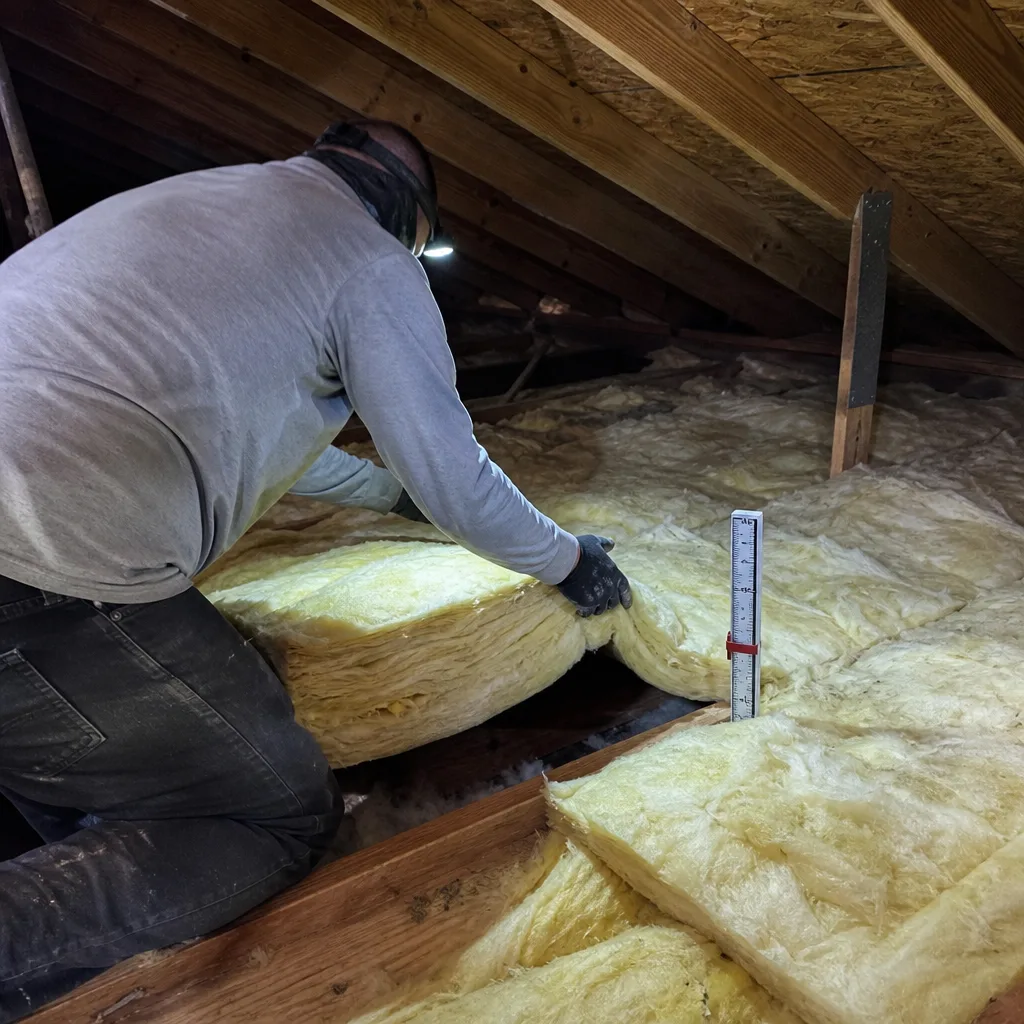
Blower-door test and thermal scan. We pressurize the house to measure CFM50 leakage, then use infrared to map where conditioned air is escaping. This number becomes our baseline.
- 3
Written price and scope. Under Haven Standard Clause 1, you get a flat price, written scope, and written warranty before anyone lifts a tool. No work starts without it.
- 4
Air sealing first, insulation second. We seal top plates, can lights, penetrations, and bypasses with foam and caulk. Seal the leaks first. The insulation has nowhere to go until you do.
- 5
Spray foam application. Open-cell or closed-cell, per the engineering: roof decks and rim joists get closed-cell for vapor control; open-cell works for above-grade walls and garage ceilings where drying to the interior matters.
- 6
Post-install documentation. Final blower-door test, documented photo record, and your copy of the readings. You keep the evidence of what changed.
What Rockwool Spray Foam Insulation Costs in Round Rock
Most Rockwool-to-spray-foam transitions in Round Rock run between $2,800 and $6,500 for a typical 2,000-square-foot home, depending on how much removal is involved and whether we’re treating attic, rim joist, or both. Rim joist-only closed-cell jobs usually fall between $1,800 and $3,200. Garage ceiling open-cell runs $2,200-$4,000 in the neighborhoods we serve, with price driven by access difficulty and whether the Rockwool removal reveals hidden moisture damage.
What moves the price: square footage of treated surface, thickness of foam specified (typically 3 inches open-cell or 2 inches closed-cell for code minimum), whether we need to remove existing Rockwool first, and any structural repairs the removal exposes. We don’t quote per-board-foot over the phone; we measure on site and give you the written price before any work starts. Call (737) 259-7528 for an exact quote - estimates are free.
Why Round Rock Homeowners Call Topside Attic Insulation Round Rock for Rockwool Work
We’ve been independently owned and operated under The Haven Standard since 2016, and we’ve sealed and insulated over 9,000 homes with written prices every time and documented records on every visit. Wes Okafor and our crew know the specific attic configurations in Williamson County - which ranch-style homes in Fern Bluff have scissor trusses that hide bypasses, which two-stories in Behrens Ranch need roof-deck foam rather than floor insulation. We also service Reflectix and other major brands, so if your project involves multiple insulation systems, we don’t subcontract the coordination. The 365-Day Done Right Promise applies to all completed work. Background-checked, uniformed technicians. Calls answered by a live person, 24/7.
FAQs
Rockwool’s product warranty covers manufacturing defects in the original material, not installation methods or subsequent modifications by other contractors. As an independent Rockwool service provider, we document the condition of existing Rockwool before modification and specify foam products that won’t chemically interact with mineral wool residues. Call (737) 259-7528 if you need help interpreting your original warranty language.
No spray foam achieves Rockwool’s inherent fire resistance - mineral wool tolerates temperatures above 2,000°F without combusting. We specify ignition-barrier-coated closed-cell foam where code requires it, and we never remove fire-rated Rockwool from assemblies where it’s serving a code-mandated function without engineering a replacement barrier. The right material for the right location.
Repair is cheaper if the Rockwool is dry, properly placed, and the only issue is minor settling or gaps. Switching to spray foam becomes cost-effective when you’re already paying for removal due to moisture damage, when air sealing is the primary goal, or when the geometry of the space makes batt installation inherently compromised. We give you both numbers in writing so you can decide.
Most Rockwool spray foam projects in Round Rock are scheduled within 48 hours and completed in one day for standard attic or rim joist work. Two-day jobs are typically complex removals or garage ceilings with limited access. You’ll get a named technician and a text when they’re on the way - under Haven Standard: Arrive on schedule.
Rockwool doesn’t manufacture spray foam - they’re a mineral wool company - so there’s no “OEM” foam to use. We source spray foam from Icynene, Demilec, and other manufacturers we trust, selected for the specific application and never locked to a proprietary product. The materials list for your job appears in your written scope before work starts.
Ready to see what your Rockwool system actually needs? Call (737) 259-7528 for a free estimate in Round Rock. Bring us any written quote you’ve already received - we’ll read it with you.
Written by Wes Okafor, Owner, Topside Attic Insulation Round Rock at Topside Attic Insulation Round Rock, serving Round Rock and nearby areas.