
GreenFiber Attic Insulation: The Round Rock Owner’s Guide
We stock and install GreenFiber blown-in cellulose attic insulation in Round Rock, with most complete attic jobs running between $1.80 and $2.40 per square foot installed depending on depth and density. Same-day installation is available when you call before noon, and we carry GreenFiber material on every truck. Most Round Rock homeowners discover their GreenFiber insulation is failing when they notice uneven temperatures between rooms, a spike in summer electric bills, or find settled, compacted material in the attic that no longer reaches the original R-value.
Which GreenFiber Models This Applies To
GreenFiber produces loose-fill cellulose insulation under two primary product lines relevant to Round Rock attics: Low Dust and SANCTUARY by GreenFiber. The Low Dust line is the standard blown-in cellulose you’ll find in most homes built between 2010 and 2020 in neighborhoods like Behrens Ranch and Fern Bluff. SANCTUARY is the higher-density, pest-resistant formulation with added borate treatment, identifiable by the green and white bag labeling and a listed settled density of 1.6 pounds per cubic foot versus 1.3 for Low Dust.
To identify what’s currently in your attic, check for leftover bags in the garage or look for a small paper specification tag stapled to a rafter near the attic access. The tag lists the installed R-value and the product name. If neither exists, we can pull a core sample during our assessment and match it to GreenFiber’s published density and fiber-length specifications.
We are an independent insulation contractor with no affiliation to GreenFiber. We source their material through standard distribution channels alongside Owens Corning, Johns Manville, and Rockwool. For most Round Rock homes, we recommend sticking with GreenFiber cellulose if that’s what’s already in place, mixing cellulose types can create density inconsistencies at the boundary layer that show up on thermal imaging as cold strips.
Signs Your GreenFiber Attic Insulation Is Failing
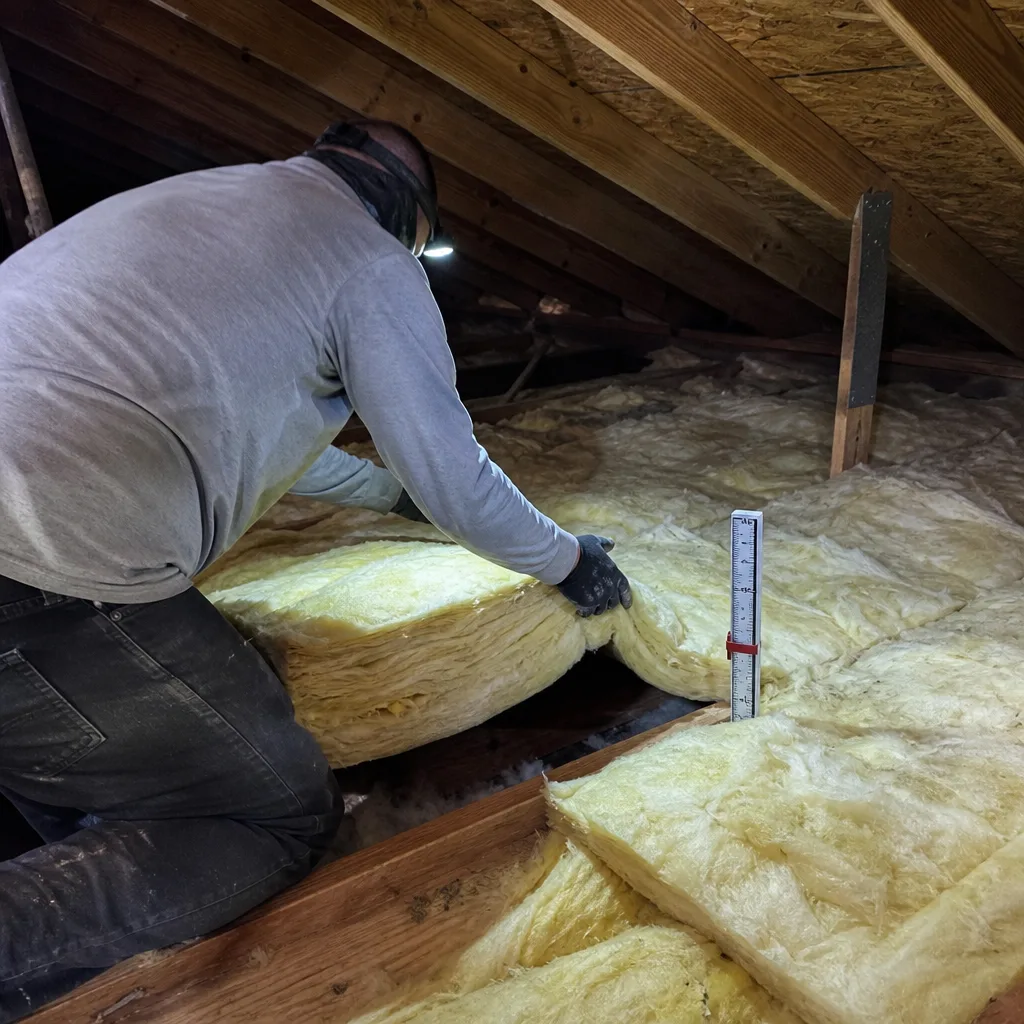
- Uneven room temperatures despite the HVAC running constantly. GreenFiber cellulose settles over time, dropping from an installed R-38 to an effective R-25 or lower in Round Rock’s heat. The material hasn’t disappeared, it’s compressed, and the thermal resistance per inch has decreased because air gaps have formed between the settled layer and the drywall below.
- Summer electric bills climbing year over year with no rate change. When GreenFiber loses loft, your attic floor becomes a heat radiator. In Round Rock’s August conditions, an uninsulated or under-insulated attic can reach 140 degrees, and your ductwork in that space becomes a convection oven for the air you’re paying to cool.
- Visible gaps or thin spots near eaves, light fixtures, or the attic hatch. These are installation gaps, not settlement. GreenFiber must be blown to a consistent depth with proper baffling at the eaves. Wind washing through soffit vents can strip material back from the edges, and trafficked areas near the hatch get compacted by foot traffic.
- Dust or insulation particles falling through recessed can lights. This indicates either the original install lacked proper sealing around top plates and fixture penetrations, or the GreenFiber has degraded to the point that it’s migrating through gaps that have opened as the house has settled. Cellulose doesn’t belong in your living space.
- Moisture stains or mold spotting on the attic side of drywall. GreenFiber’s borate treatment resists mold, but if air leaks are bringing humid conditioned air into a cold attic in winter, the moisture condenses on the sheathing before the insulation can manage it. The insulation isn’t the primary failure, the air sealing is, and adding more GreenFiber over the leak makes it worse.
Replacement Cost & What’s Included
For a typical 2,200-square-foot attic in Round Rock, complete removal of failed GreenFiber and replacement with new material runs between $3,960 and $5,280. Add $800 to $1,400 for air sealing of top plates, can lights, and penetrations if the original job skipped that step, which we see in roughly sixty percent of homes built during the 2012 to 2018 construction rush in Williamson County.
Top-up installations, where existing GreenFiber is still in reasonable condition but has settled below target depth, cost less, typically $1,200 to $2,100 for the same footprint. We measure existing depth with a ruled probe at twelve points across the attic floor and calculate the cubic feet needed to restore your target R-value.
Every job includes our Documented Photo Record, a written scope with flat pricing signed before work starts, and on applicable jobs, before-and-after blower-door readings. The 365-Day Done Right Promise applies. Under Haven Standard: you get the written price, the written warranty, and the documented result.
DIY or Call Us?
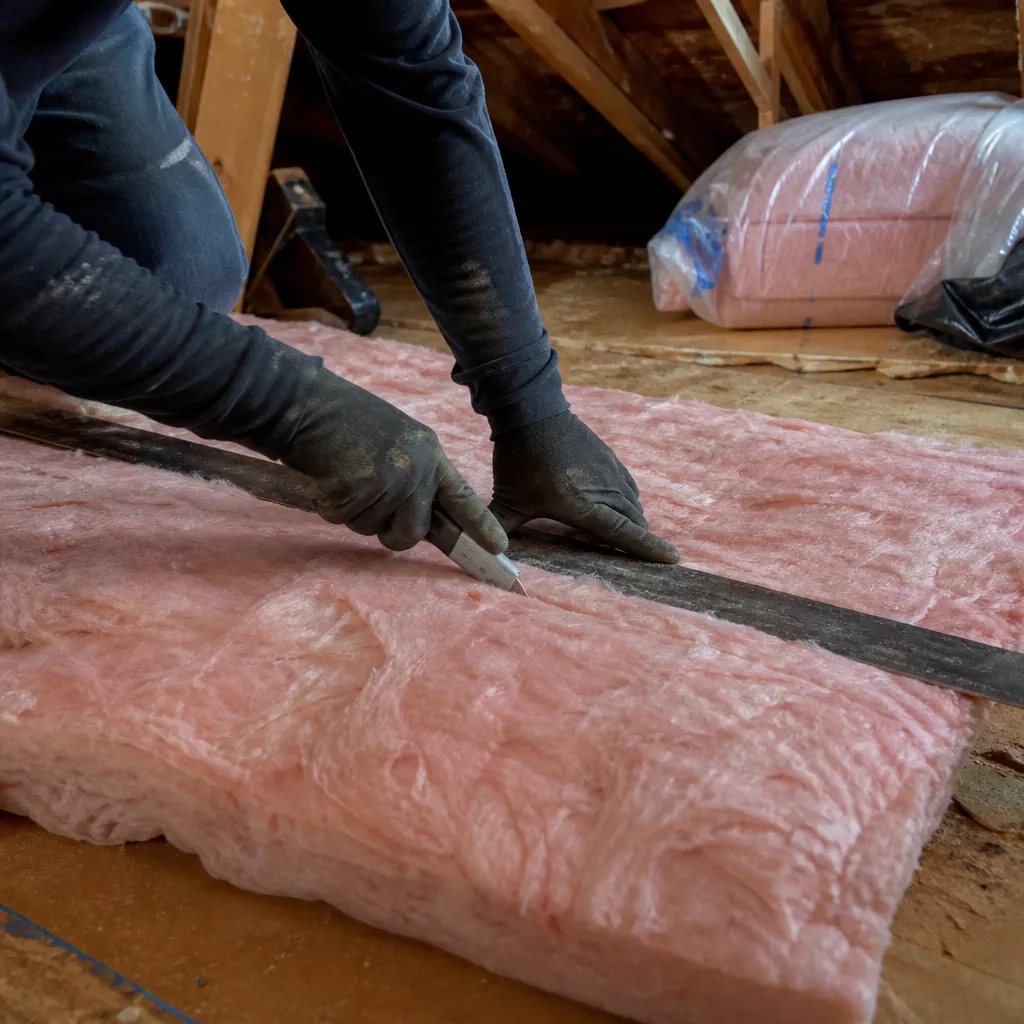
Here’s what you can safely check yourself. Verify your attic access is secure, look for visible gaps near the eaves, and note any insulation falling through fixtures. A quick visual with a flashlight tells you if the material looks uniformly deep or if you’re seeing bare drywall, ductwork, or the tops of ceiling joists.
What you shouldn’t do: rent a blower and add more GreenFiber over an unsealed attic floor. Cellulose blown over air leaks simply filters the escaping conditioned air. You’ll get dust in your insulation, uneven density, and no performance gain. The blower-door test, a pressurization reading that shows in one number how much air your building envelope is losing, is the only way to know what needs sealing before any new material goes in.
Seal the leaks first. The insulation has nowhere to go until you do.
For homes with vermiculite or pre-1990 insulation, stop and call us. Disturbing older material without proper containment is a genuine health hazard. Otherwise, call (737) 259-7528 for a free assessment and written price.
FAQs
GreenFiber cellulose maintains its rated R-value for roughly 20 to 30 years if installed at proper density and the attic is properly air-sealed. In Round Rock’s climate, the bigger threat than age is settlement combined with thermal cycling, our summer attic temperatures cause repeated expansion and contraction that accelerates compaction in under-dense installs. Call (737) 259-7528 for a depth check if your home is over ten years old.
Partial top-ups work if the existing material is dry, uncontaminated, and hasn’t been compressed by foot traffic or storage. We probe for moisture content and check for rodent activity; if either is present, removal and replacement is the only sound option. A free assessment gives you the repair-versus-replace answer specific to your attic.
Most complete removals and replacements in a standard Round Rock home finish in one day, with air sealing adding a second day on about forty percent of jobs. We send a two-person crew, and you don’t need to be home after the initial walkthrough. You’ll receive your Documented Photo Record and blower-door results by email that evening.
We carry GreenFiber Low Dust and SANCTUARY material on every truck, along with Owens Corning, Johns Manville, Knauf, Rockwool, and Reflectix products. No proprietary lock-in means we match the material to your home’s needs and your existing insulation type. Same-day installation is available in Round Rock when you call before noon and your job doesn’t require removal of contaminated material.
Written by Wes Okafor, Owner, Topside Attic Insulation Round Rock at Topside Attic Insulation Round Rock, serving Round Rock and nearby areas.