
Knauf Attic Insulation: The Round Rock Owner’s Guide
We stock and install Knauf-compatible blown-in fiberglass attic insulation in Round Rock, TX with most residential retrofits running between $1.80 and $2.40 per square foot installed depending on target R-value and existing conditions. Same-day installation is available when we have your target depth and square footage confirmed by phone. Most Round Rock homeowners discover their Knauf insulation is failing when the second floor won’t hold temperature, energy bills spike between May and September, or a home inspector flags compressed or displaced batts during a sale.
Which Knauf Models This Applies To
Knauf’s residential attic line in Central Texas is dominated by Jet Stream Ultra blown-in fiberglass and Ecobatt with ECOSE Technology, though we also encounter legacy InsulSafe SP and NatuRoll installations from the 2010s. The critical compatibility gotcha in Round Rock’s 78664, 78665, and 78681 ZIP codes: Jet Stream Ultra requires a minimum 1,000 CFM blowing machine (Knauf’s Momentum or equivalent) to achieve the labeled settled density of 0.5 pounds per cubic foot. A standard rental unit from the hardware store runs closer to 400 CFM and will leave you with uneven coverage and a false sense of R-value.
To identify what you have, check the attic hatch or a removed batt for the Knauf label. Jet Stream bags are white with green lettering; Ecobatt is brown-tinted from the ECOSE binder, not the yellow-pink of standard fiberglass. If you’re matching existing insulation for a repair or addition, mixing Knauf with generic blown-in creates thermal drift at the boundary - different settle rates, different densities. We stock OEM Knauf on our Round Rock trucks and can source Johns Manville, Owens Corning, or Rockwool equivalents when a full attic replacement makes more sense than matching aging material. Topside Attic Insulation Round Rock is an independent service provider; we are not affiliated with Knauf Insulation.
Signs Your Knauf Attic Insulation Is Failing
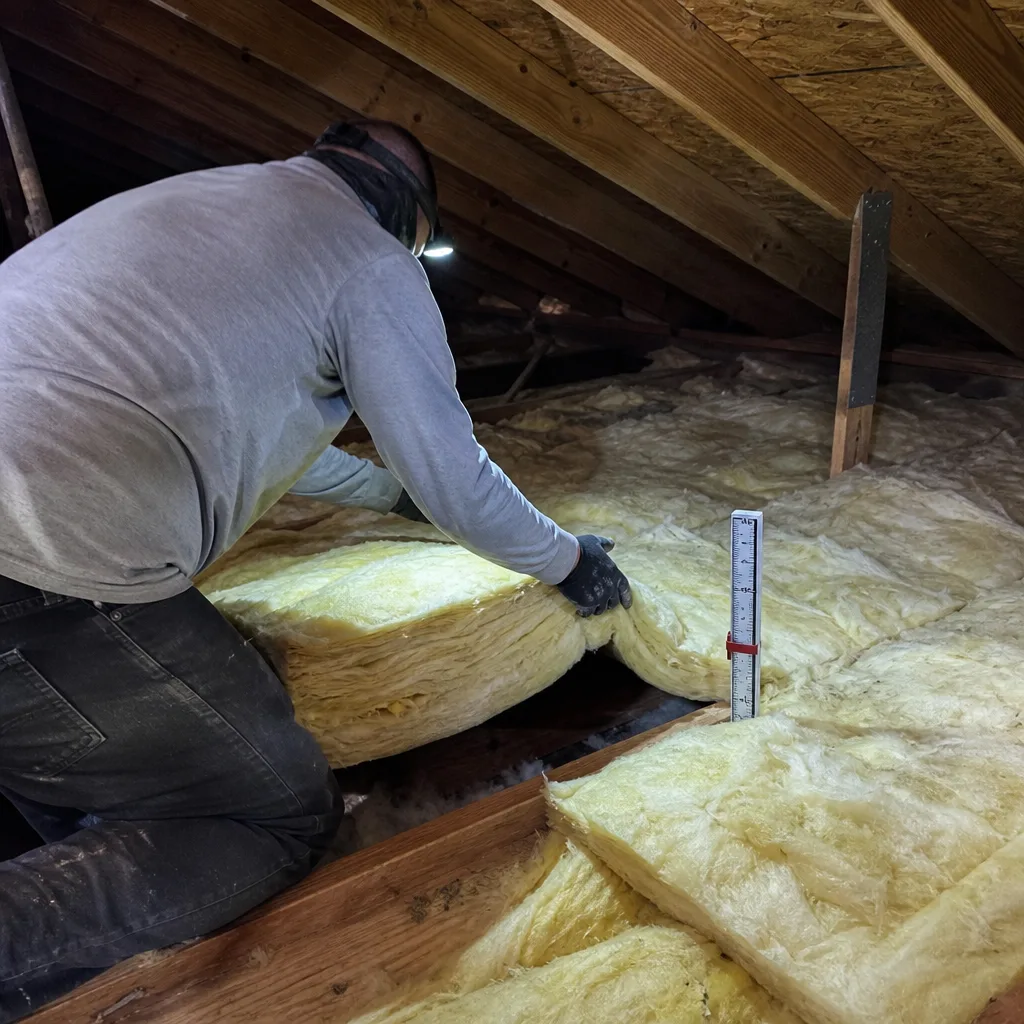
- Uneven temperature between floors. In Round Rock’s clay-heavy soils, foundation settling cracks the ceiling plane over time. Conditioned air leaks through these gaps and bypasses Knauf batts laid flat. We find this constantly in 1990s-era homes near Old Settlers Park where truss uplift has pulled the ceiling drywall away from top plates.
- Energy bills climbing year-over-year with no rate change. Fiberglass doesn’t degrade chemically, but it does settle and compress. Jet Stream Ultra rated at R-38 when blown to 14.5 inches can compress to R-26 or lower after a decade of storage traffic, rodent nesting, or homeowner walking.
- Hot spots on the ceiling in August afternoons. This is usually failed air sealing beneath the Knauf layer, not the insulation itself. In Williamson County’s 100-degree days, a 2-inch gap around a recessed can light becomes a chimney for attic heat. The Knauf material is fine; it’s just not designed to block airflow, only slow conductive heat.
- Visible moisture or dark staining on insulation surface. Knauf’s ECOSE binder resists mold better than phenolic binders, but it won’t stop condensation from a bathroom vent dumping humid air into the attic. We see this in Round Rock’s newer builds near Teravista where exhaust fans were spec’d to terminate at the soffit but never connected.
- Insulation displaced from eave edges or pulled back from soffit vents. Wind washing through poorly baffled soffits strips lightweight blown-in fiberglass from perimeter zones. Jet Stream Ultra at 0.5 pcf is particularly vulnerable; we’ve found bare drywall at the eaves in homes less than five years old.
Replacement Cost & What’s Included
Most Knauf attic insulation replacements in Round Rock run between $1.80 and $2.40 per square foot for blown-in fiberglass to current IECC code (R-38 to R-49 depending on your home’s construction year). A typical 1,800 square foot attic with removal of existing compressed material, full air sealing of top plates and penetrations, and new Jet Stream Ultra installation lands between $3,200 and $4,300.
What drives the range: accessibility (steep roof pitch or limited hatch size), existing insulation removal (adds $0.40-$0.60 per square foot), and whether we need to build storage decking or light platforms after the work. Every job includes our written scope and written warranty under Haven Standard Clause 1 - flat price, no surprises - plus a Documented Photo Record and before-and-after blower-door numbers when air sealing is part of the scope. Our 365-Day Done Right Promise covers all completed work.
DIY or Call Us?
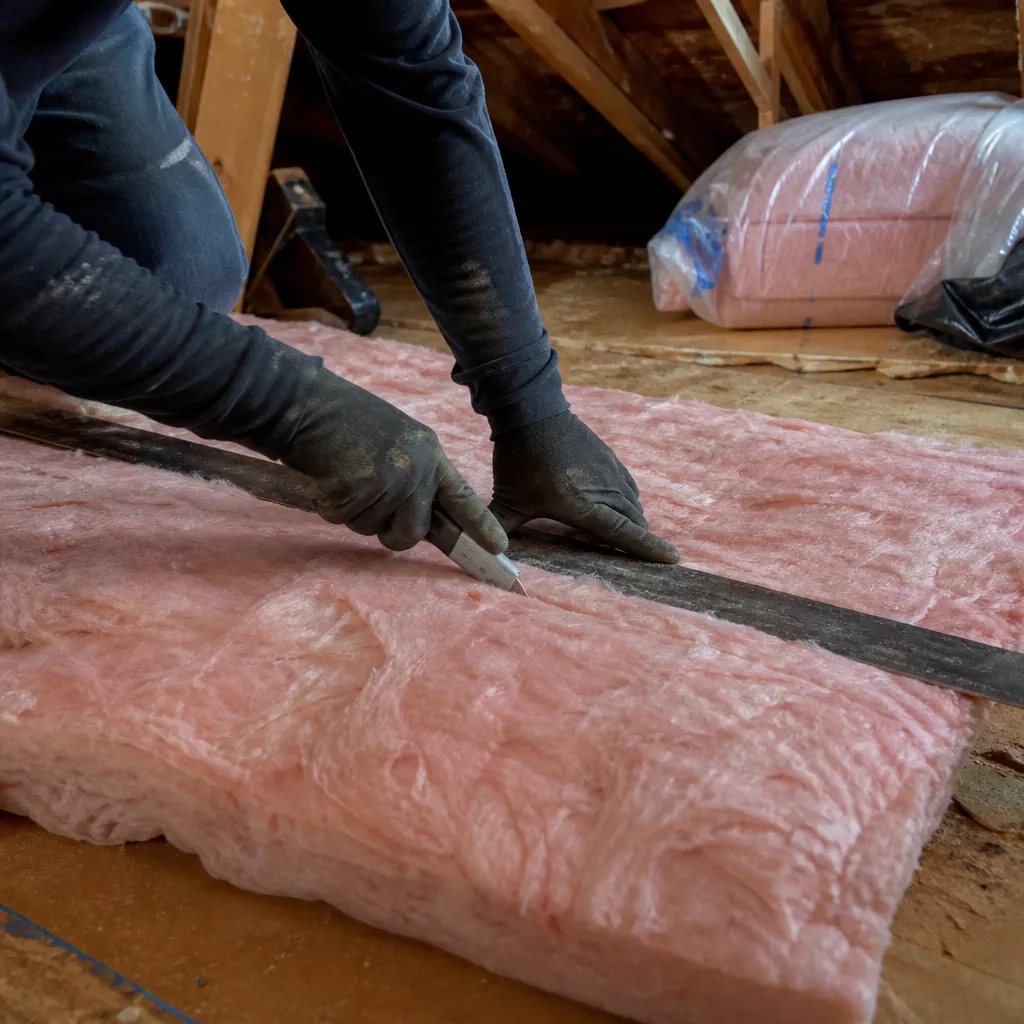
There’s nothing inherently dangerous about handling Knauf fiberglass insulation - it’s not high-tension or electrical work - but there are honest limits to what a homeowner can verify. You can safely check your attic hatch for the Knauf label, measure existing depth with a yardstick, and photograph any obvious gaps or compressed areas. What you cannot reliably assess from a Home Depot trip: whether your attic floor is leaking 2,000 CFM50 of conditioned air through hidden bypasses, whether your soffit baffles are intact, or whether your target R-value calculation accounts for the thermal bridging of your truss chords.
We’ve corrected enough DIY blow-in jobs in Round Rock to know the pattern: even coverage at the center, bare spots at the eaves, and a blower-door reading that hasn’t moved because nobody sealed first. Seal the leaks first. The insulation has nowhere to go until you do. Call (737) 259-7528 and we’ll walk through what you’re seeing - free second opinion on any written estimate you already have.
FAQs
Knauf fiberglass insulation itself is chemically stable for decades, but its installed performance degrades when it settles, compresses, or gets wind-washed. In Round Rock’s combination of intense attic heat (150°F+ in summer) and seasonal humidity swings, we typically see Jet Stream Ultra lose effective R-value after 10-15 years unless it was installed at proper density with intact air sealing beneath. Call (737) 259-7528 for a free assessment of your current depth and condition.
Spot repair is viable when the failure is isolated - a single disturbed area from a prior service call, or a small zone of compression. We can blow matching Knauf material to blend with existing. Full replacement is the honest recommendation when more than 30% of the attic shows settling below labeled depth, when the existing material is contaminated with rodent waste, or when the air sealing beneath was never done properly. We stock Knauf on our Round Rock trucks for either scenario.
Most residential jobs in Round Rock are completed in one day: removal of existing material in the morning, air sealing and blower-door verification midday, then blow-in installation and final documentation. Larger homes or those with complex attic geometries (multiple dormers, conditioned attic storage, or spray foam transitions) may extend to a second day. We text your named technician’s arrival window the morning of.
We stock Knauf Jet Stream Ultra and Ecobatt on our Round Rock service trucks, along with Owens Corning, Johns Manville, Rockwool, and other brands. No material wait for standard R-value targets. Specialty depths or hybrid assemblies (flash-and-batt with spray foam, for example) may require a 24-48 hour order, but we’ll confirm material availability when we deliver your written price - before any work starts, per Haven Standard Clause 1.
Written by Wes Okafor, Owner, Topside Attic Insulation Round Rock at Topside Attic Insulation Round Rock, serving Round Rock and nearby areas.