

Trusted Spray Foam Insulation for Round Rock Homeowners
Our guide on how much Spray Foam Insulation costs breaks down why Round Rock prices typically fall between $1.80 and $4.50 per board foot depending on open-cell or closed-cell product, and most residential jobs are completed in one to two days. At Topside Attic Insulation Round Rock, we’ve sealed and insulated over 9,000 homes since 2016, and every job starts with a written price before any work begins. We’re independently owned and operated under The Haven Standard, and a live person answers our phones 24/7 at (737) 259-7528.
Round Rock’s combination of hot, humid summers and occasional hard freezes puts serious stress on building envelopes. Homes built between 2015 and 2025 in neighborhoods like Teravista, Behrens Ranch, and Forest Creek often have good-looking insulation that leaks conditioned air through rim joists, garage ceilings, and roof deck penetrations. We’ve measured blower-door readings over 4,000 CFM50 in newer homes that looked fine from the attic hatch, something we also address with Spray Foam Insulation in Pflugerville homes facing similar climate stress. The problem isn’t always visible. That’s why we seal first, then insulate, and publish before-and-after blower-door numbers on every applicable job so you can see the actual performance change.
What Our Spray Foam Insulation Service Includes
Open-Cell Spray Foam
Open-cell spray foam is a lightweight, semi-rigid foam with a density of about 0.5 pounds per cubic foot, used primarily in above-grade walls and attic floors where vapor permeability is desired. In Round Rock’s climate, we use it in stud cavities and cathedral ceilings where the assembly needs to dry to the interior. At Topside Attic Insulation Round Rock, we never install open-cell foam until top plates, electrical penetrations, and can-light boxes are sealed with targeted air sealing. The result is a wall or ceiling that insulates and breathes without leaking your conditioned air into the attic.
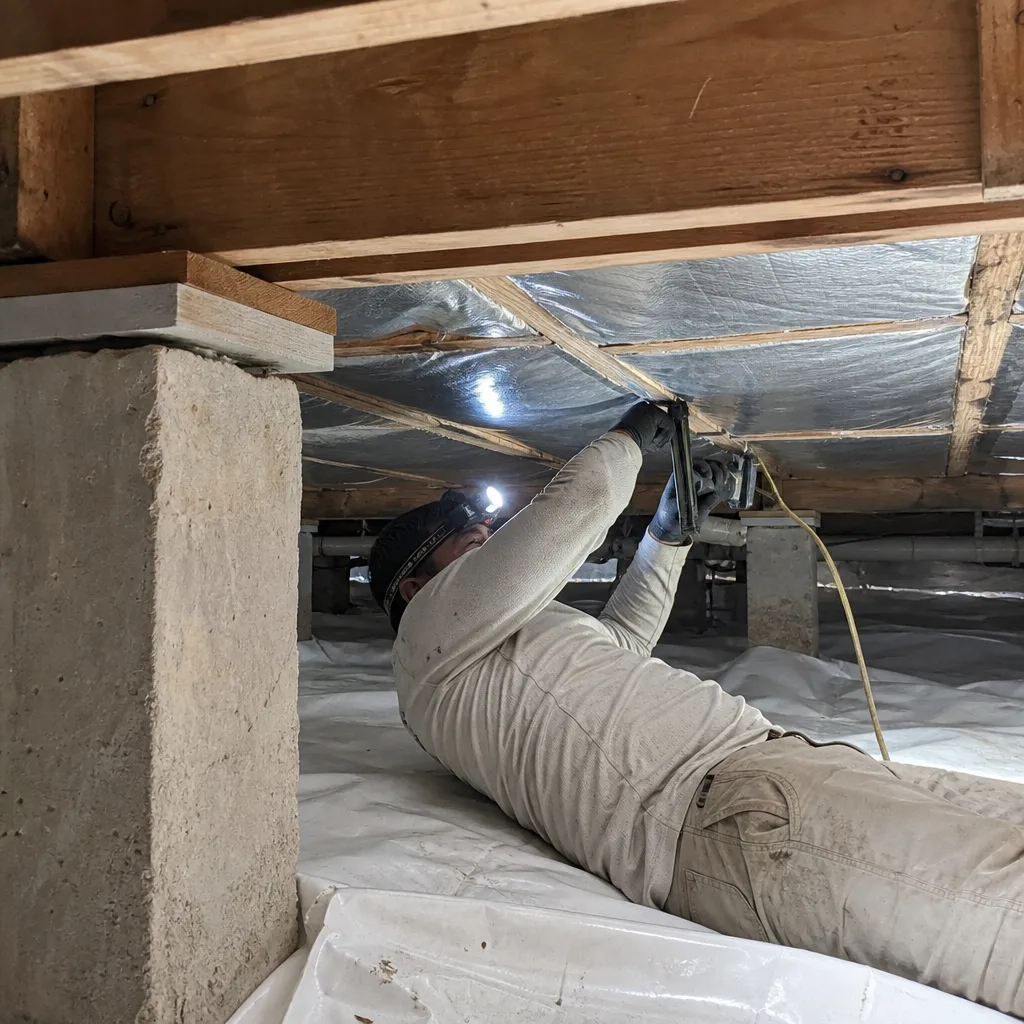
Closed-Cell Spray Foam
Closed-cell spray foam is a denser, rigid foam at roughly 2.0 pounds per cubic foot that acts as both insulation and vapor barrier, with an R-value of approximately R-6.5 per inch. We use it in Round Rock crawl spaces, rim joists, and any location where moisture control is critical, especially in homes near Brushy Creek or the San Gabriel River watershed where seasonal humidity spikes. Our crews apply it in lifts to prevent overheating, and we document the pass-by-pass thickness with photos you’ll receive in your Documented Photo Record. Closed-cell is also the right choice for garage ceiling applications where a rigid, durable surface matters.
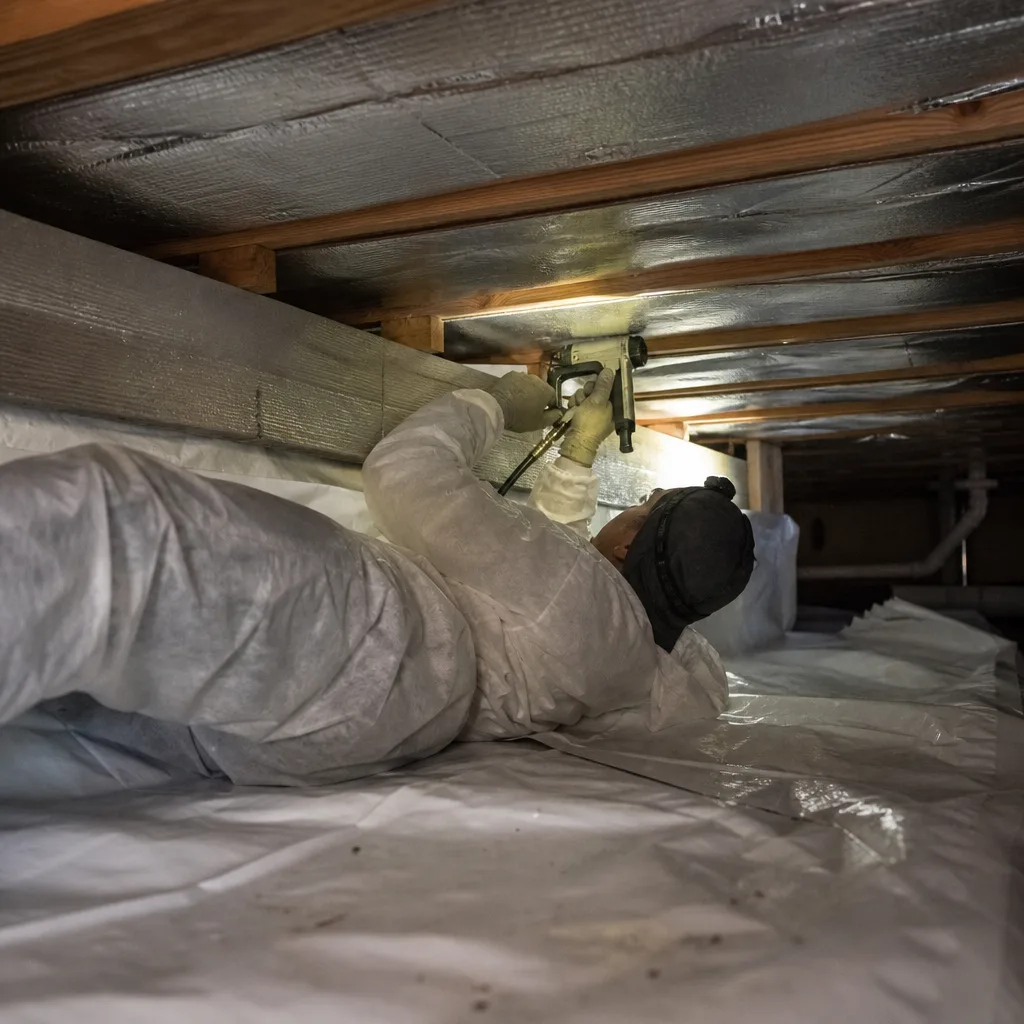
Rim Joist Spray Foam
The rim joist is the perimeter band where your foundation meets the first floor, and in Round Rock it’s often the leakiest part of the building envelope. Fiberglass stuffed in rim joist bays doesn’t seal air movement, and in our climate that means hot, humid outdoor air meets cool conditioned surfaces in summer, creating condensation and mold risk. We remove any existing batt insulation, clean the surface, and apply closed-cell spray foam directly to the rim joist and sill plate assembly. On every job we run a blower-door test before and after, and we’ve seen single-digit air changes per hour improvements from rim joist work alone in homes near Old Settlers Park and La Frontera.
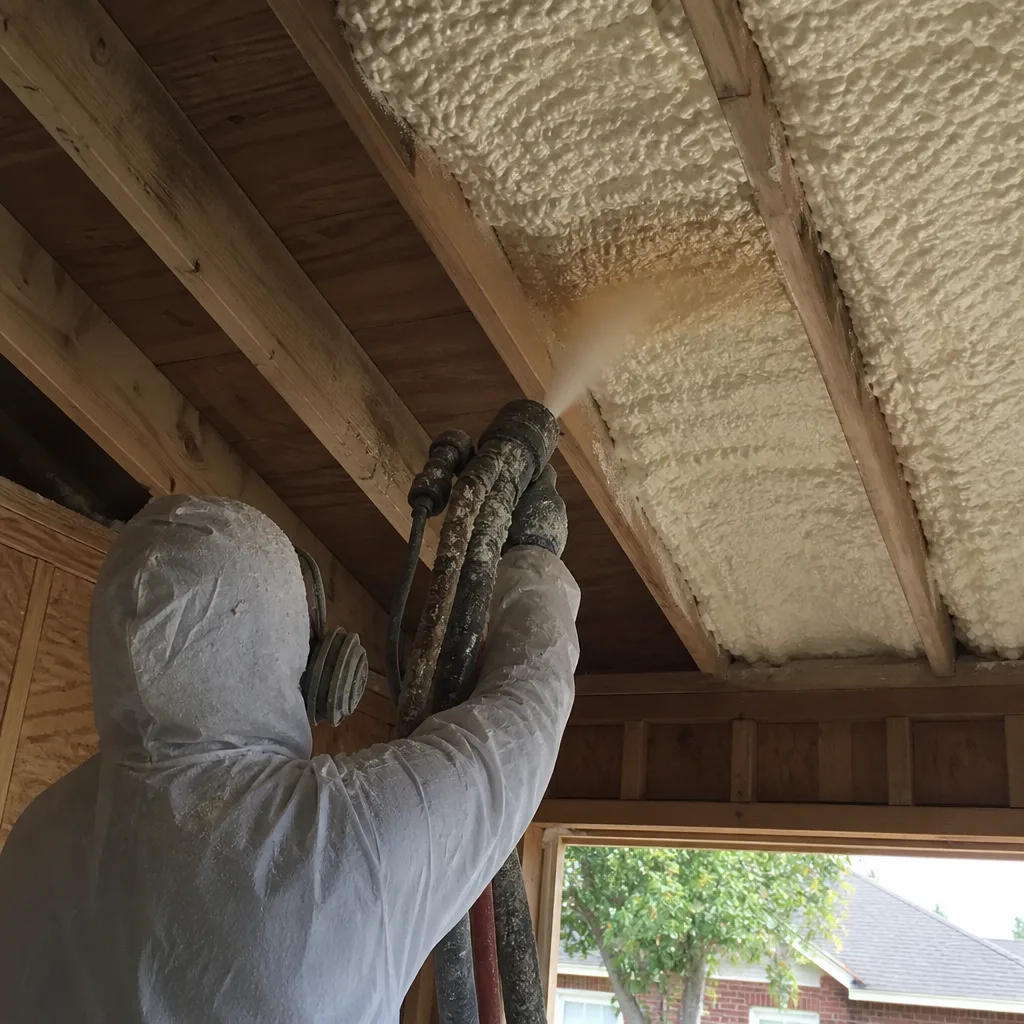
Garage Ceiling Spray Foam
Garage ceiling spray foam addresses the thermal boundary between conditioned living space and an unconditioned garage, particularly in Round Rock’s popular two-story plans with bonus rooms above garages. The garage ceiling is rarely air-sealed during original construction, meaning your bedroom floor is essentially exposed to a 120-degree attic-like space in July, a problem we solve with Hutto Spray Foam Insulation as well. We spray closed-cell foam to the garage ceiling deck, sealing around duct boots, wiring, and plumbing penetrations as we go. The result is a floor assembly that performs like an exterior wall, and homeowners in neighborhoods like Paloma Lake and Highlands at Mayfield report immediate temperature stability in the rooms above.
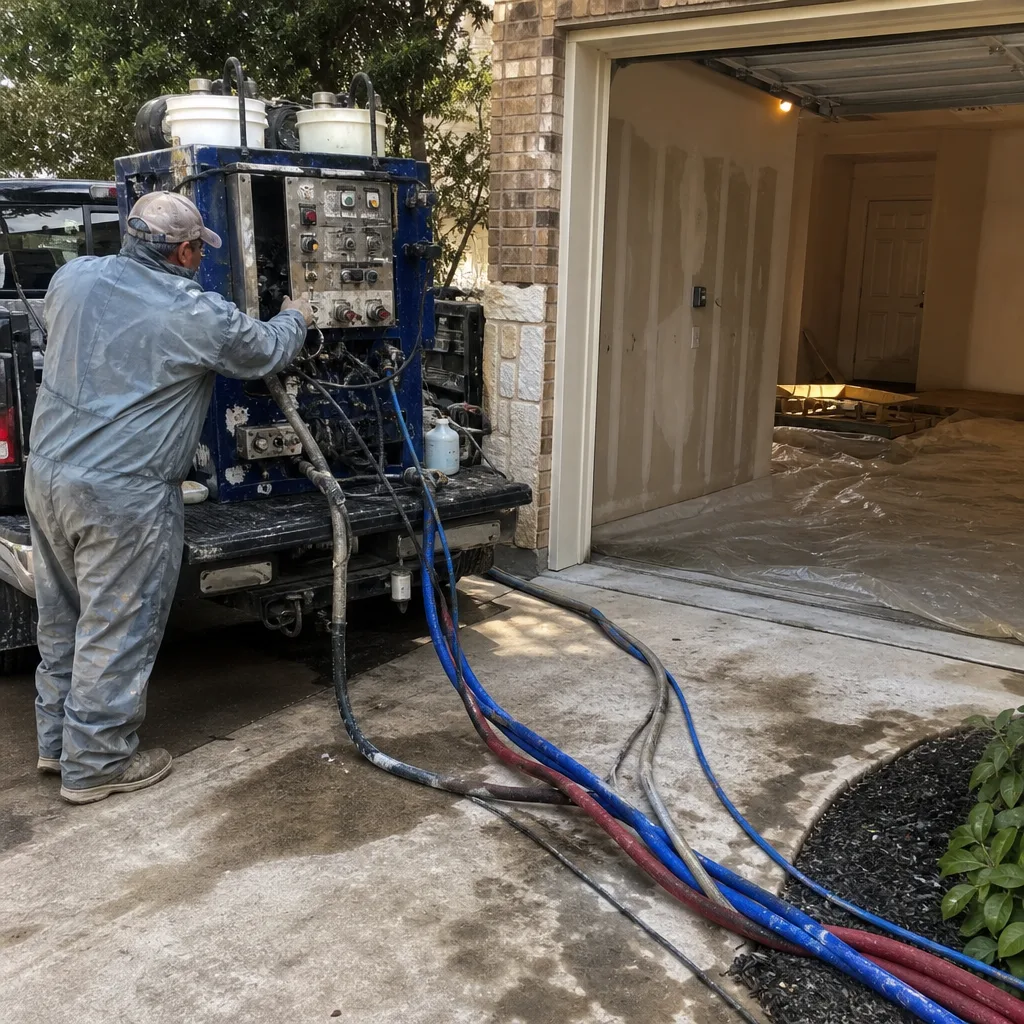
Spray Foam Roof Deck
Spray foam applied directly to the underside of the roof deck converts your attic from a ventilated, unconditioned space to an unventilated, conditioned space within the thermal envelope. In Round Rock, this approach eliminates the complex ventilation requirements of traditional attics and removes the ductwork from extreme temperature swings. Our crews apply open-cell foam to the full roof deck surface, extending down to the top plate at the eaves, with careful attention to baffle installation where ridge vents previously existed. We then run a blower-door test to confirm the attic is no longer communicating with outside air. This is particularly effective for homes with HVAC equipment in the attic, which describes most of the inventory in Round Rock’s 2015-2025 construction boom, and it’s a key part of our Spray Foam Insulation in Round Rock service.
What happens when you call
- 1
A real person answersNo phone trees - you reach a local pro.
- 2
You get an upfront price rangeHonest numbers before anyone is dispatched.
- 3
A background-checked tech heads outLicensed & insured, dispatched right away.
- 4
You approve before work beginsNothing starts until you say go.
Brands We Service for Spray Foam Insulation
We source spray foam materials from multiple manufacturers including Johns Manville, Knauf, and CertainTeed, and we maintain current certifications with each supplier’s application requirements. Johns Manville’s Corbond line performs consistently in Round Rock’s high-temperature summer applications, and our crews have completed hundreds of jobs using their closed-cell formulations without callback for adhesion failure. Knauf’s Ecose technology reduces VOC off-gassing during cure, which matters in occupied homes where residents stay in the house during installation. CertainTeed’s Intellifoam products integrate well with their broader building envelope systems, and we specify them when the project includes complementary insulation upgrades.
We don’t carry proprietary product lock-in. Whether your architect specified a particular brand, your builder used a specific foam on the original construction, or you’re comparing material options, we can source and install it. Our written scope of work names the exact product, density, and thickness before anyone starts spraying. Bring us a competing quote and we’ll review it with you under our Free Second Opinion policy.
Signs You Need Spray Foam Insulation Right Now
- Your upstairs rooms are 8-12 degrees hotter than downstairs in July. This temperature stratification usually means your attic floor or roof deck is leaking conditioned air faster than your HVAC can replace it. In Round Rock’s climate, we measure this with a blower-door test and infrared camera, then target spray foam to the specific failure points.
- You can see daylight through rim joist bays in your crawl space or basement. Any visible gap at the foundation perimeter is an uncontrolled air pathway. We’ve found rim joist gaps pulling 40+ CFM50 on blower-door tests in homes throughout Wells Branch and Brushy Creek, and spray foam is the only repair that both seals and insulates in one application.
- Your energy bills spike every June and don’t drop until October. Round Rock’s cooling degree days exceed heating degree days by a wide margin, so summer bill spikes are the tell. If your usage pattern tracks with outdoor temperature more tightly than it should, your envelope is underperforming and spray foam at key leakage points typically reduces HVAC runtime by 15-30%.
- You smell attic air in your living space when the HVAC runs. This means your ductwork or air handler is located in a ventilated attic and the return side is pulling attic air through leaks. Spray foam on the roof deck converts the attic to conditioned space, eliminating this pressure differential and the indoor air quality problem it creates.
- Your garage ceiling has moisture stains or the room above is always uncomfortable. The garage ceiling is rarely treated as a thermal boundary during construction, yet it separates your most extreme unconditioned space from frequently occupied rooms. Closed-cell spray foam applied to the garage ceiling deck solves both the thermal and air leakage problems with one treatment.
Our Spray Foam Insulation Process - Step by Step
- 1
Initial consultation and written price. We visit your Round Rock home, identify the target application areas, and take preliminary photos. Within 24 hours you receive a written scope with flat pricing, named materials, and the blower-door testing protocol. Under Haven Standard Clause 1, no work starts without your signed approval of this document.
- 2
Pre-installation blower-door test and air sealing. On applicable jobs, we pressurize the house with a blower door to establish the baseline CFM50 reading. Our technicians then seal top plates, electrical and plumbing penetrations, can-light boxes, and duct boots with targeted air sealing. We never spray foam over an unsealed surface. The air sealing is completed and documented before foam application begins.
- 3
Surface preparation and masking. We protect floors, windows, and finished surfaces with polyethylene sheeting and masking tape. Spray foam overspray is permanent, so this step is non-negotiable. Our crews wear full protective equipment and ventilate the work area according to manufacturer specifications for the specific product being applied.
- 4
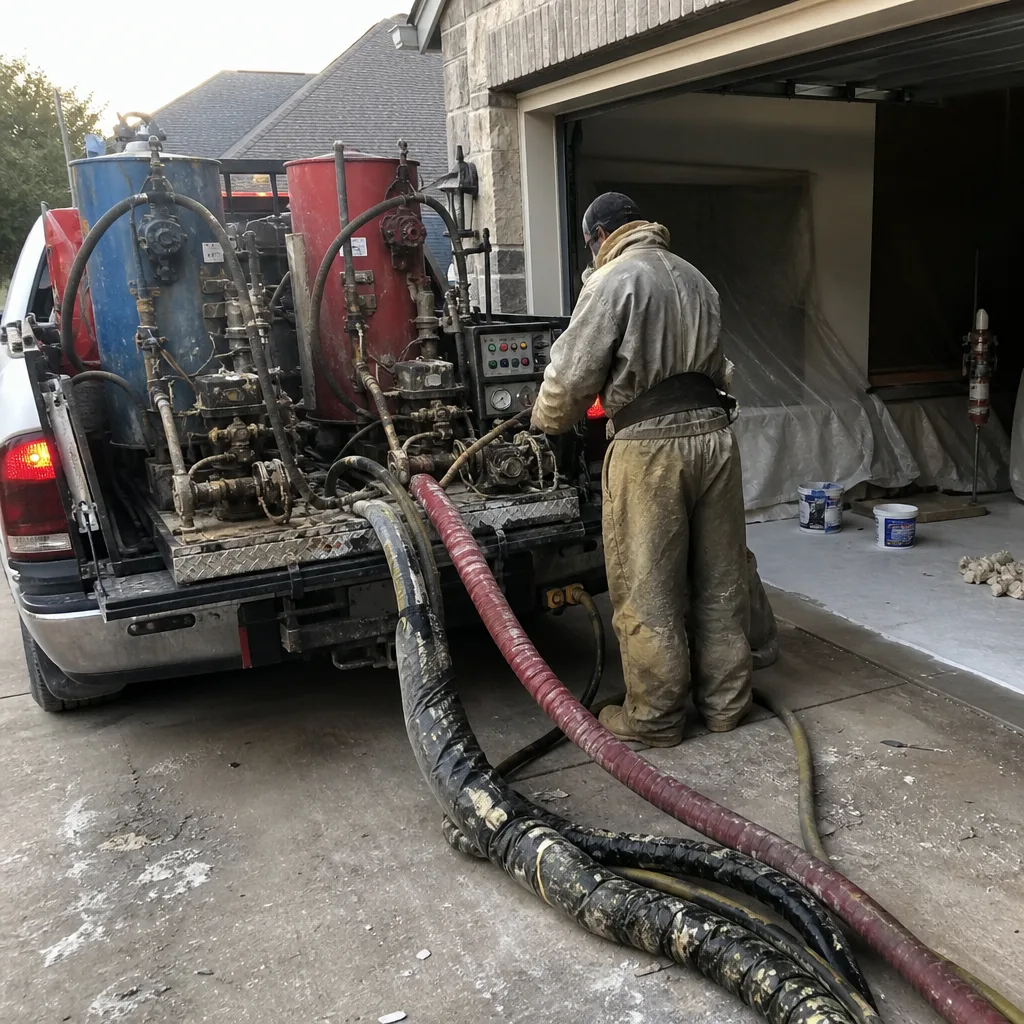
Spray foam application in controlled lifts. The foam is applied in passes of specified thickness, with cooling periods between lifts to prevent exothermic reaction damage. We measure pass thickness with a depth gauge and photograph each stage. The material is allowed to cure fully before any trim work or reinstallation of fixtures.
- 5
Post-installation testing, documentation, and walkthrough. We run a second blower-door test to measure the air leakage reduction, then compile your Documented Photo Record with before-and-after images, pass-by-pass thickness readings, and both blower-door numbers. You receive the written record, the warranty documentation, and a walkthrough of what was done before we leave.
How Much Does Spray Foam Insulation Cost in Round Rock?
A typical open-cell spray foam application to an attic roof deck in a 2,000-square-foot Round Rock home runs between $3,800 and $6,500 depending on roof pitch, accessibility, and the condition of existing ventilation that must be modified. Closed-cell rim joist work in a standard crawl space or basement perimeter typically costs $1,200 to $2,800. Garage ceiling applications range from $1,500 to $3,200 for a two-car garage with standard ceiling height. Whole-house applications combining multiple areas generally fall between $6,500 and $12,000.
Several factors move these numbers. Roof pitch above 8/12 requires scaffolding or specialized platform work. Existing insulation removal adds $1.00 to $2.50 per square foot depending on material type and contamination. Homes in Round Rock’s older neighborhoods like Round Rock Original or Kenningston sometimes have irregular framing or knob-and-tube wiring remnants that require additional preparation. The specific foam density and brand also affect material cost, with closed-cell formulations running roughly double the per-board-foot price of open-cell.
To avoid overpaying, get competing quotes in writing and compare them line by line. We offer a Free Second Opinion on any written estimate, and we’ll walk through the scope differences with you. Our written price includes all preparation, application, cleanup, testing, and documentation. There are no line items added after you sign.
Every free estimate includes a blower-door test where applicable, infrared imaging to identify thermal bypasses, and a written scope with flat pricing. Call (737) 259-7528 to schedule.
Spray Foam Insulation Near Round Rock - Our Service Area
We work throughout the Round Rock metro and surrounding communities including Spray Foam Insulation in Brushy Creek, Spray Foam Insulation in Wells Branch, Pflugerville, Hutto, Jollyville, Cedar Park, Georgetown, Leander, Manor, Taylor, and Austin. Typical response time for estimates in Round Rock proper is same-day or next-day; outlying areas like Georgetown or Manor usually see us within 48 hours. We carry the full range of open-cell and closed-cell formulations on our trucks, so most jobs begin within a week of estimate approval.
Serving Round Rock, TX - Our Local Coverage Area
We’re based in the Round Rock area and know this community well. Use the map below to see our service coverage - if you’re nearby, we can almost certainly help.
Frequently Asked Questions - Spray Foam Insulation in Round Rock
Spray foam insulation is a two-component chemical mixture that expands on contact with surfaces to create a continuous, adherent insulation and air barrier. Unlike fiberglass batts or blown cellulose, which can leave gaps and don’t seal air movement, spray foam bonds to framing members and penetrations to stop both conductive heat flow and convective air leakage. In Round Rock’s climate, this dual function matters because summer attic temperatures exceed 140 degrees and even small air pathways move significant heat into conditioned space.
Most residential spray foam jobs in Round Rock are completed in one to two days, with an additional 24-hour curing period before full occupancy of the treated space. A standard rim joist application takes four to six hours; a full roof deck on a 2,500-square-foot home typically requires two days including preparation, application in lifts, and post-installation testing. We schedule start dates after your written approval and text you when the crew is en route.
Open-cell spray foam runs approximately $1.80 to $3.20 per board foot installed, while closed-cell ranges from $3.00 to $4.50 per board foot. A typical Round Rock attic roof deck application costs $3,800 to $6,500; rim joist work runs $1,200 to $2,800; garage ceilings fall between $1,500 and $3,200. Your written estimate breaks down material, labor, and any preparation costs specifically. Call (737) 259-7528 for an exact quote on your home, estimates are free.
Yes. We source and install Johns Manville, Knauf, and CertainTeed spray foam products, and our crews maintain current application certifications with each manufacturer. We don’t claim exclusive or preferred status with any brand, and we select the specific product based on your project’s performance requirements, not distributor incentives. Your written scope names the exact product and density before work begins.
We answer calls 24/7 and can typically respond to urgent situations, such as failed insulation discovered during a real estate transaction or post-storm envelope damage, within 24 hours in Round Rock. True emergencies in spray foam are rare, most issues develop over seasons, not hours. If you’re facing a deadline or unexpected failure, call (737) 259-7528 and we’ll prioritize your schedule.
All spray foam work is covered by our 365-Day Done Right Promise, if it’s not done right, we make it right. Additionally, the manufacturer’s product warranty applies for defects in the foam itself, typically 10 years to lifetime depending on brand and application. You receive both warranties in writing, along with your scope and blower-door documentation, before any work starts. Haven Standard: Have it in writing.
Remove stored items from the work area, ensure access to electrical panels, and plan to vacate the house during application and for 24 hours after while the foam cures and off-gasses. We handle all surface protection, masking, and ventilation setup. If you have pets, arrange for them to be off-site during the cure period. Your project manager provides a specific preparation checklist with your written scope.
Schedule Your Spray Foam Insulation Service in Round Rock Today
Call (737) 259-7528 to speak with a live person 24/7 and schedule your free estimate. We’ll run a blower-door test where applicable, identify your specific air leakage paths, and deliver a written price before any work starts. Every job closes with a Documented Photo Record and, on applicable work, published before-and-after blower-door numbers so you can verify the performance you paid for. Under Haven Standard: Have it in writing.
Written by Wes Okafor, Owner at Topside Attic Insulation Round Rock, serving Round Rock since 2016.