
Attic Batt Insulation in Round Rock, TX
Attic batt insulation is pre-cut fiberglass or mineral wool panels installed between the framing members of your attic floor – the joists – to slow heat transfer between your living space and the attic above. In Round Rock, where summer attic temperatures regularly push past 140°F and air conditioning runs from April through October, the thermal barrier you put in those joist bays matters more than almost any other envelope decision you’ll make. If your energy bills have climbed, your upstairs rooms won’t cool down, or you’re replacing HVAC equipment ahead of schedule, Attic Insulation services for the attic floor are usually the first place worth looking.
Topside Attic Insulation Round Rock has been installing attic batt insulation under The Haven Standard since 2016, and every job starts the same way: air sealing before a single batt goes in, a written price before anyone lifts a tool, and a documented photo record when the crew leaves. If you’d like a number specific to your home, call us at (737) 259-7528 – estimates are free and we’ll put the price in writing before scheduling anything. You can also read more about everything we do in the attic on our Attic Insulation in Round Rock page.
When You Need Attic Batt Insulation
Batt insulation doesn’t last forever, and Round Rock’s heat cycles accelerate the degradation - which is why Attic Insulation Replacement is often needed. The following situations are the ones we see most often when we pull the attic access door open in homes across the area.
- Your upstairs rooms stay 5-8°F warmer than downstairs, even with the thermostat cranked. In neighborhoods like Teravista and Forest Creek, where two-story homes are common, this temperature split almost always traces back to an underperforming attic floor – either the insulation has settled below R-38 or it was never installed correctly in the first place.
- Your existing batts are compressed, water-stained, or sitting against the roof deck instead of the attic floor. This happens when insulation is pushed aside during HVAC maintenance or when a past installer placed it against the wrong surface. Compressed fiberglass loses R-value fast – a 6-inch batt pressed to 3 inches performs like a 3-inch batt.
- You’re in a home built between 1985 and 2005 that has never had an insulation upgrade. Code minimums from that era allowed R-19 or R-30 in attic floors. Round Rock’s current energy code calls for R-38 minimum; Energy Star and most energy auditors recommend R-49 to R-60 for this climate zone (Zone 2).
- Your gas or electric bills spiked after a renovation that opened the attic. Contractors running new ductwork, adding a bath fan, or installing recessed lighting frequently disturb existing batts and never replace them correctly. We see this regularly in homes in the Stone Oak Ranch and Paloma Lake areas.
- You’re finishing a bonus room or enclosing knee walls. Batt insulation is the standard solution for framed knee walls and the sloped ceiling sections in bonus rooms – it fits precisely in the cavity, stays put, and can be vapor-managed correctly for this climate.
- A home energy audit flagged your attic as the highest-priority improvement. If a blower-door test – a pressurization reading that shows, in one number, how much air your building envelope is losing – came back high and the auditor pointed at the attic, batt insulation combined with air sealing is usually the fastest path to a measurable improvement.
Our Attic Batt Insulation Process
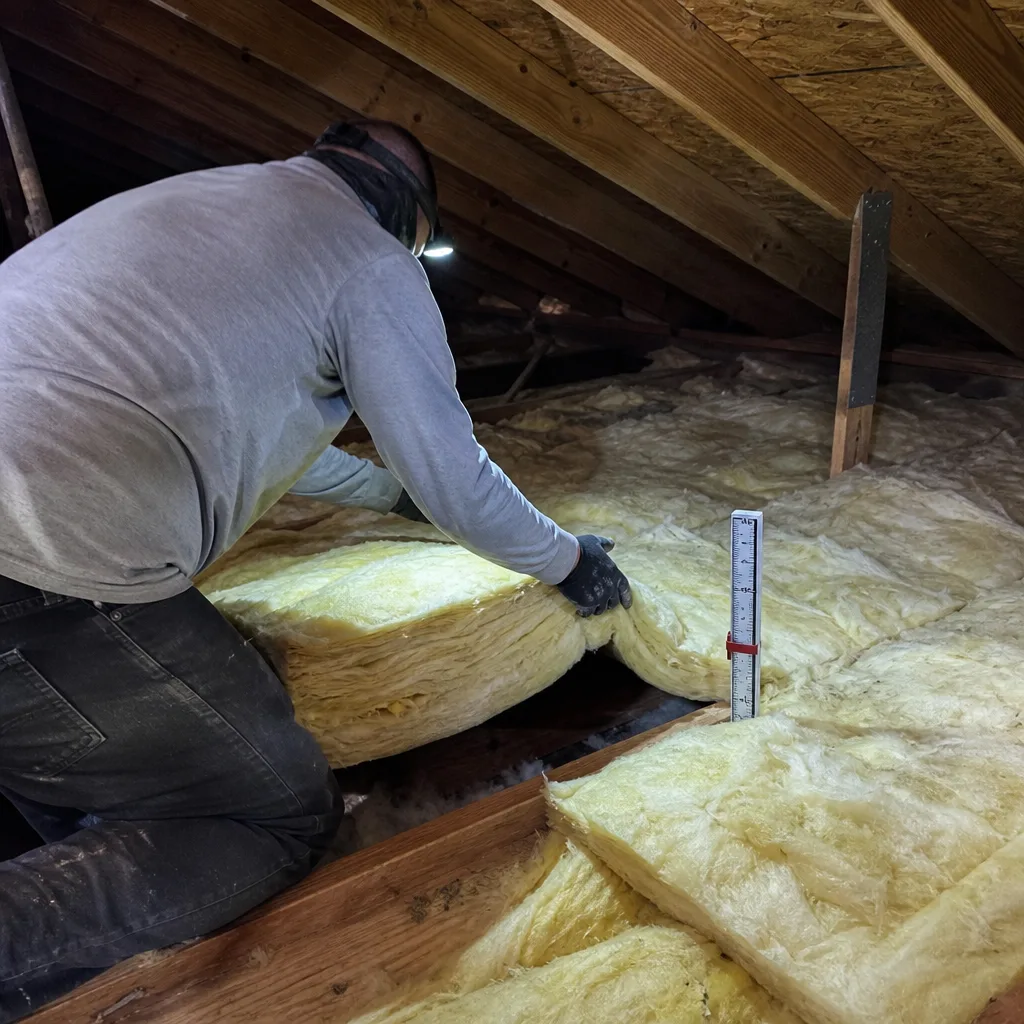
The sequence below is not flexible. We don’t skip air sealing to save time, and we don’t start insulating until the written price has been reviewed and signed off. That’s Haven Standard, not a talking point.
- Pre-installation inspection and blower-door baseline. Before we price anything, a technician reads your attic floor – joist spacing, existing R-value (if any), condition of existing material, and the location of every penetration, top plate gap, and recessed can light. On applicable jobs, we run a blower-door test at this stage to document the starting point. You’ll see that number on your paperwork. The inspection is free and generates no obligation.
- Written price, scope, and warranty – before any work starts. Under Haven Standard Clause 1, you receive a flat written price tied to a specific scope before anyone returns to do the work. The document names the material (brand and R-value), the square footage being covered, and what air sealing work is included. If anything changes on install day, the price and scope are revised in writing before we proceed.
- Air sealing of all attic floor penetrations. This is the step most contractors skip or sell as an add-on. We treat it as the prerequisite. Top plate gaps, plumbing penetrations, wiring chases, HVAC boots, and recessed can lights are sealed with fire-rated caulk, spray foam, or rigid covers before the first batt goes in. There is no meaningful benefit to adding insulation over an attic floor that still leaks conditioned air freely – the math doesn’t work.
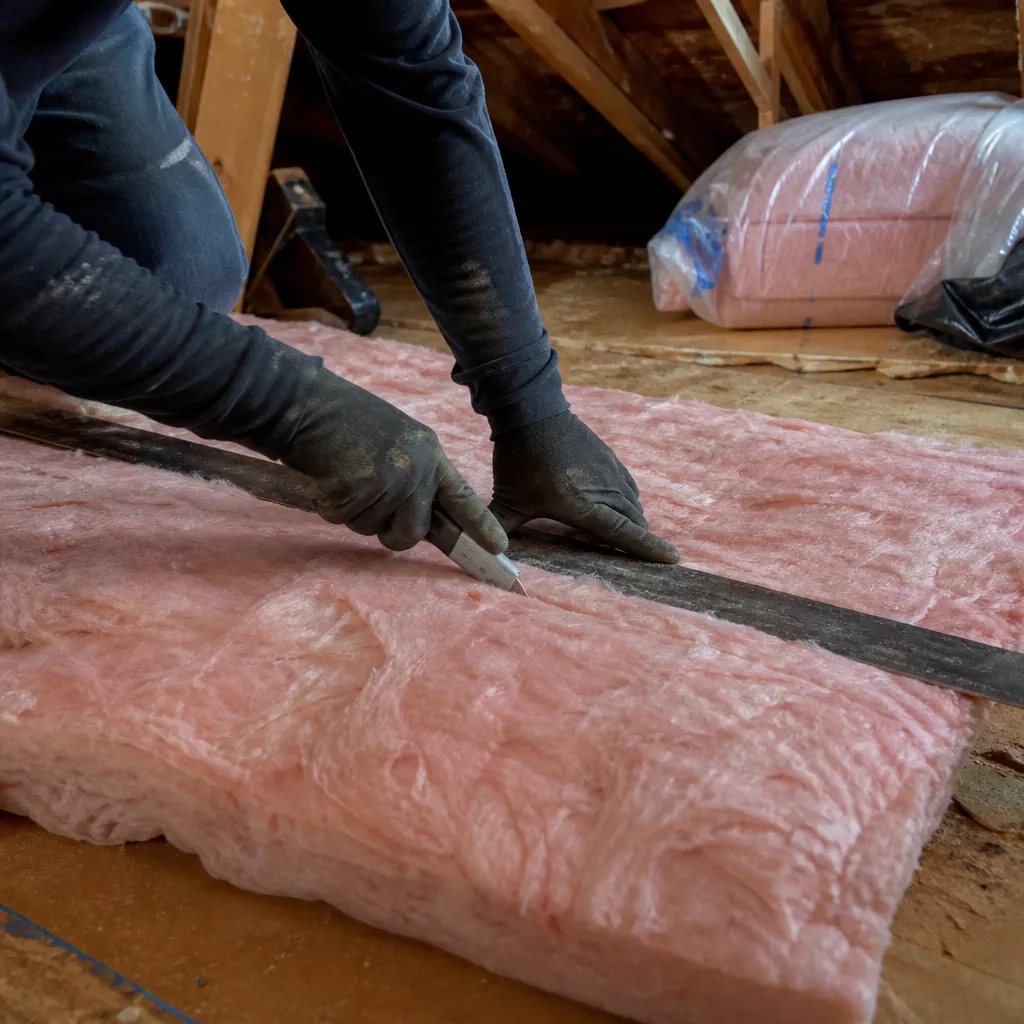
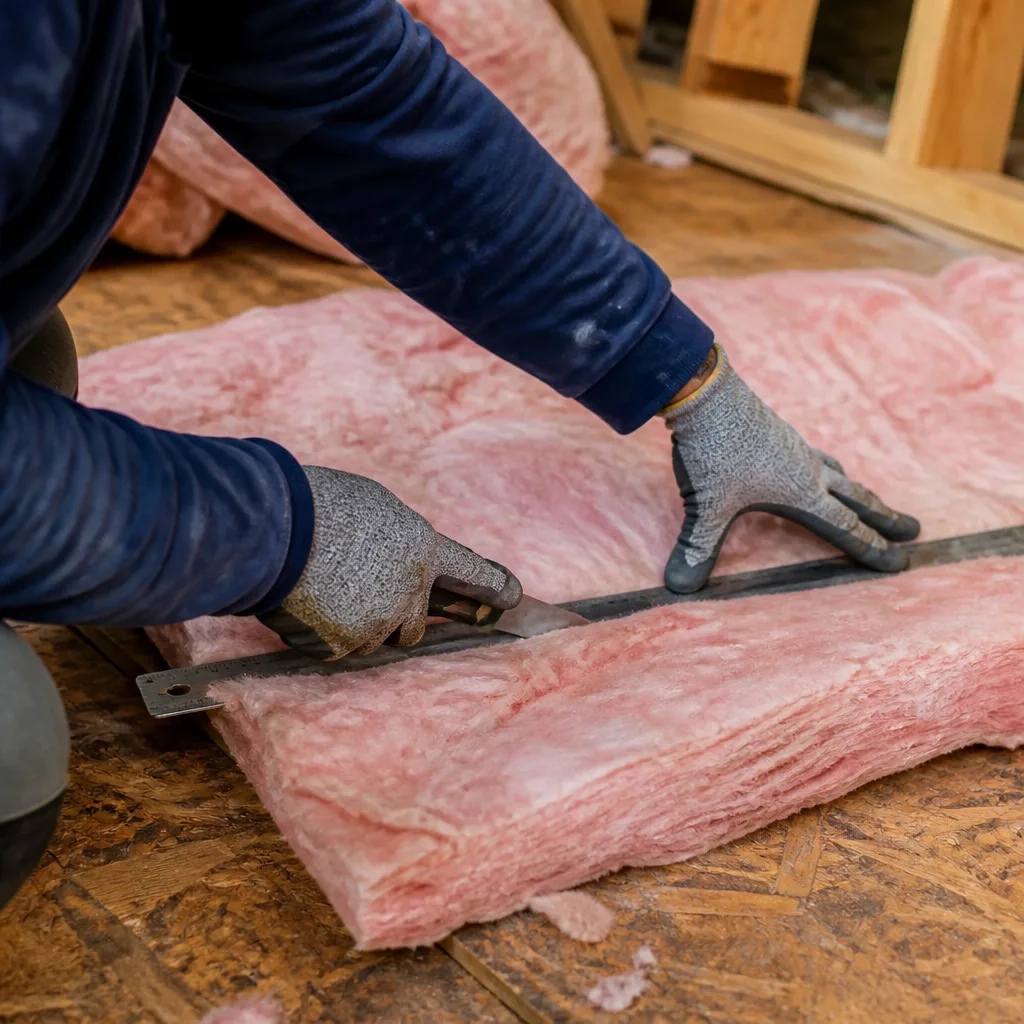
- Batt installation, cut-and-fit, and coverage verification. Batts are cut to fit the full depth of each joist bay with no gaps at the ends and no compression against obstacles. For R-49 and above, we layer – a friction-fit layer in the joist cavity, then a perpendicular layer across the joists to eliminate thermal bridging through the wood framing. We use materials from manufacturers including Johns Manville and Rockwool depending on the application – standard fiberglass batts for most attic floors, mineral wool where fire resistance or moisture tolerance is a priority.
- Post-installation blower-door test (applicable jobs) and photo documentation. On jobs where air sealing was performed, we run a second blower-door reading after the work is complete. Both numbers go on your closing paperwork so you can see what changed. Every job – whether or not a blower-door is part of the scope – closes with a documented photo record. You receive photos of the before condition, the air sealing work, and the finished insulation.
- Written warranty delivery and 365-Day Done Right Promise activation. Your warranty is handed to you in writing on the day the job closes, not mailed later. The 365-Day Done Right Promise applies from that date: if something isn’t right within the first year, we come back and make it right – no arbitration, no service fee.
Attic Batt Insulation Pricing in Round Rock
Most attic batt insulation jobs in Round Rock fall between $1.50 and $2.80 per square foot installed, including materials and labor - see How Much Does Attic Insulation Cost? (2026 Price Guide) - Round Rock, TX for full details. For a typical 1,400- to 2,000-square-foot attic floor, that puts the total project range at roughly $2,100 to $5,600. Air sealing – which we require before any insulation install – adds between $300 and $900 depending on the number and condition of penetrations in your attic floor.
Here’s what moves that number up or down:
- Target R-value. R-38 costs less than R-49 or R-60. Most Round Rock homeowners targeting an Energy Star certification or a meaningful utility bill reduction land at R-49. At R-60, a second perpendicular layer is required, which adds material and labor.
- Material type. Standard fiberglass batts (Johns Manville, Knauf) are typically priced 15-25% below mineral wool (Rockwool). Mineral wool is worth the difference in areas with moisture history or where fire rating matters – near a fireplace chase, for example.
- Existing insulation condition. If we’re installing over clean, correctly positioned existing batts, cost is lower. If existing material has to come out first – because it’s rodent-contaminated, water-damaged, or incorrectly positioned – that’s a separate line item. We document it in photos before we touch anything.
- Attic access and layout complexity. A simple open attic in a single-story ranch in Round Rock’s Mayfield Ranch area is straightforward. An attic broken up by HVAC equipment, low-slope sections, or multiple access points takes more time, and the price reflects that.
- Air sealing volume. Older homes in Round Rock’s established subdivisions near Brushy Creek – built in the 1990s and early 2000s – often have more penetrations and more first-generation recessed lighting than newer construction in Highlands at Mayfield Ranch or Siena. More penetrations mean more air sealing time and material.
We do not post a single price and ask you to fit yourself into it. Under Haven Standard Clause 1, the written price you receive is specific to your home’s square footage, material choice, and air sealing scope. Call (737) 259-7528 to schedule a free inspection – we’ll measure, assess, and hand you a flat written number before anything else happens.
FAQs – Attic Batt Insulation
What R-value do I need for attic batt insulation in Round Rock, TX?
Round Rock sits in Climate Zone 2, and the current International Energy Conservation Code (IECC) minimum for attic floors in this zone is R-38. In practice, most homeowners see a better return at R-49, and Energy Star’s guidelines for Zone 2 call for R-49 to R-60 in attic floors. Homes built before 2005 frequently have R-19 or R-30 from the original install – less than half of what current standards recommend. If you’re not sure what you have, we’ll measure it during the free inspection and put the target R-value in writing before we quote anything. Call (737) 259-7528 to schedule that visit.
Is attic batt insulation better than blown-in insulation for my home?
Batts and blown-in insulation are both effective when installed correctly – the right choice depends on your attic’s specific layout. Batts are the cleaner option for open joist bays with standard framing spacing (16 or 24 inches on center), for knee walls in bonus rooms, and for any framed cavity where the insulation needs to stay exactly where it’s placed. Blown-in cellulose or fiberglass is often faster in large open attics and fills irregular spaces more completely. Many jobs in Round Rock use both: batts in the joist bays around the perimeter, blown-in to fill and top-up the field. We’ll tell you which approach makes more sense for your specific attic during the inspection – and if it’s a combination, the written price will break out both line items clearly.
Can you install attic batt insulation without doing air sealing first?
We don’t, and here’s the practical reason: an attic floor with unsealed top plates, can lights, and plumbing penetrations acts like a chimney. Hot attic air – or in winter, cold outside air – moves through those gaps regardless of how thick the insulation layer is above or below them. Adding R-49 batts over a leaky floor is like putting a heavy blanket on top of an open window. The insulation slows conduction, but the infiltration and exfiltration continue. Sealing first then insulating is the only sequence that addresses both heat transfer mechanisms. On applicable jobs, we document the improvement with a before-and-after blower-door reading so you can see the result in a single number, not just take our word for it.
How long does attic batt insulation last in Round Rock’s climate?
Fiberglass batts installed correctly in a dry, ventilated attic will hold most of their R-value for 20-30 years. The factors that shorten that lifespan in Round Rock are moisture intrusion (a roof leak that saturates the batts), HVAC maintenance traffic that compresses or displaces them, and rodent activity – which we document during the inspection if present. Mineral wool batts from a manufacturer like Rockwool are more resistant to both moisture and compression and tend to hold their rated R-value longer in our climate. Either way, we photograph the starting condition, install to a verified depth, and leave you with documentation so the next person who opens that attic hatch knows exactly what’s up there and when it went in.
What Sets Our Batt Installation Apart
There are contractors in Round Rock who will install batt insulation in a morning without ever picking up an air-sealing gun. We’ve seen the results in attics across the area – thick, clean insulation sitting over top plates with gaps wide enough to put your hand through. The thermal resistance looks fine on paper. The home’s actual performance doesn’t match.
Topside Attic Insulation Round Rock operates as part of Envelope Insulation Co., which has sealed and insulated more than 9,000 homes since 2016, every one under a written price and every one closed with a documented photo record. Wes Okafor built this operation on a simple premise: a homeowner who can see the before-and-after blower-door numbers on their own paperwork doesn’t have to trust anyone’s word about whether the work was worth doing. The numbers say what they say.
We’re independently owned and operated, which means our material choices aren’t dictated by a supply agreement. If Johns Manville fiberglass is the right batt for your joist bay depth and budget, that’s what goes in. If the application calls for Rockwool mineral wool – a flat attic section with historical moisture, a knee wall adjacent to a bathroom – we’ll specify that and explain why. The written scope names the brand and R-value before the crew shows up.
The 365-Day Done Right Promise applies to every batt job we complete. If the installation develops a problem – a displaced batt, a cold spot that wasn’t there before, a section we missed – you call us and we come back. No fee, no negotiation. That’s what the written warranty says, and the written warranty is what you walk away with when the job closes. You can also explore everything we cover under the broader home service line if you want to understand how attic batt insulation fits into the full building envelope picture.
Key Takeaways
- Round Rock’s Climate Zone 2 requires a minimum of R-38 in attic floors; R-49 is the practical target for most homes seeking meaningful energy savings.
- Air sealing top plates, can lights, and penetrations is completed before any batt goes in – it’s not an add-on, it’s the prerequisite.
- Before-and-after blower-door readings are included on applicable jobs so you can verify the air-sealing result in a single number.
- Most attic batt insulation jobs in Round Rock run $2,100 to $5,600 for a 1,400- to 2,000-square-foot attic floor, with a written price delivered before any work starts.
- Material choices include Johns Manville and Rockwool depending on application – no proprietary lock-in.
- Every job closes with a documented photo record and a written warranty; the 365-Day Done Right Promise applies from that date.
Schedule Your Free Attic Batt Insulation Estimate in Round Rock
If your upstairs rooms aren’t cooling the way they should, your utility bills are climbing, or you simply don’t know what R-value is currently in your attic floor, searching for Attic Insulation Near Me in Round Rock, TX is the right starting point with a free inspection. A Topside Attic Insulation Round Rock technician will measure the existing insulation, identify every air sealing opportunity, and hand you a flat written price before leaving – no estimate window, no follow-up pressure. Call (737) 259-7528 and a live person will answer. We serve Round Rock and the surrounding communities, and we’ve been doing this under The Haven Standard since 2016.
Written by Wes Okafor, Owner at Topside Attic Insulation Round Rock, serving Round Rock.