
Last updated September 24, 2026
Seasonal Insulation Care for Round Rock: Year-Round Homeowner’s Guide
The February 2021 freeze caused more attic insulation damage in Central Texas from burst pipe spray and condensation reversal than the previous ten summers combined. Yet most seasonal guides published since then still treat winter as the low-stress season for insulation. In Round Rock, that assumption is dangerous. Our two distinct stress seasons, a latent-heat summer that runs roughly May through October and a short but spike-cold winter that occasionally drops to the low teens, produce failure modes so different they require separate inspection focuses, not a single annual walkthrough. This guide covers what to check, when to check it, and the two metrics you can track yourself to catch problems before they become four-figure repairs. For a deeper dive, see The Complete Guide to Insulation in Round Rock.
Quick Answer
Seasonal insulation care in Round Rock means a summer inspection focused on attic ventilation and HVAC duct integrity, plus a pre-winter inspection focused on pipe exposure, prior freeze damage, and stack-effect reversal at bypasses. Homeowners should track attic peak temperature with a $15 min-max thermometer and utility cost per degree-day to normalize year-over-year performance. Post-storm checks after hail or straight-line wind events are also critical, as displaced ridge vents and soffit covers can saturate insulation from above. For a full seasonal breakdown, see our Attic Insulation Maintenance Checklist for Round Rock Homeowners.
Table of Contents
- Summer Inspection Focus: Latent Heat and Duct Stress
- Pre-Winter Inspection Focus: Post-2021 Freeze Awareness
- Stack Effect Reversal: What Hard Freezes Do to Your Envelope
- Two Metrics Homeowners Can Track Themselves
- Post-Storm Protocol for Hail and Wind Events
- Insulation Materials That Hold Up in Round Rock’s Climate
- Common Mistakes to Avoid
- When to Call a Professional
- Frequently Asked Questions
Summer Inspection Focus: Latent Heat and Duct Stress
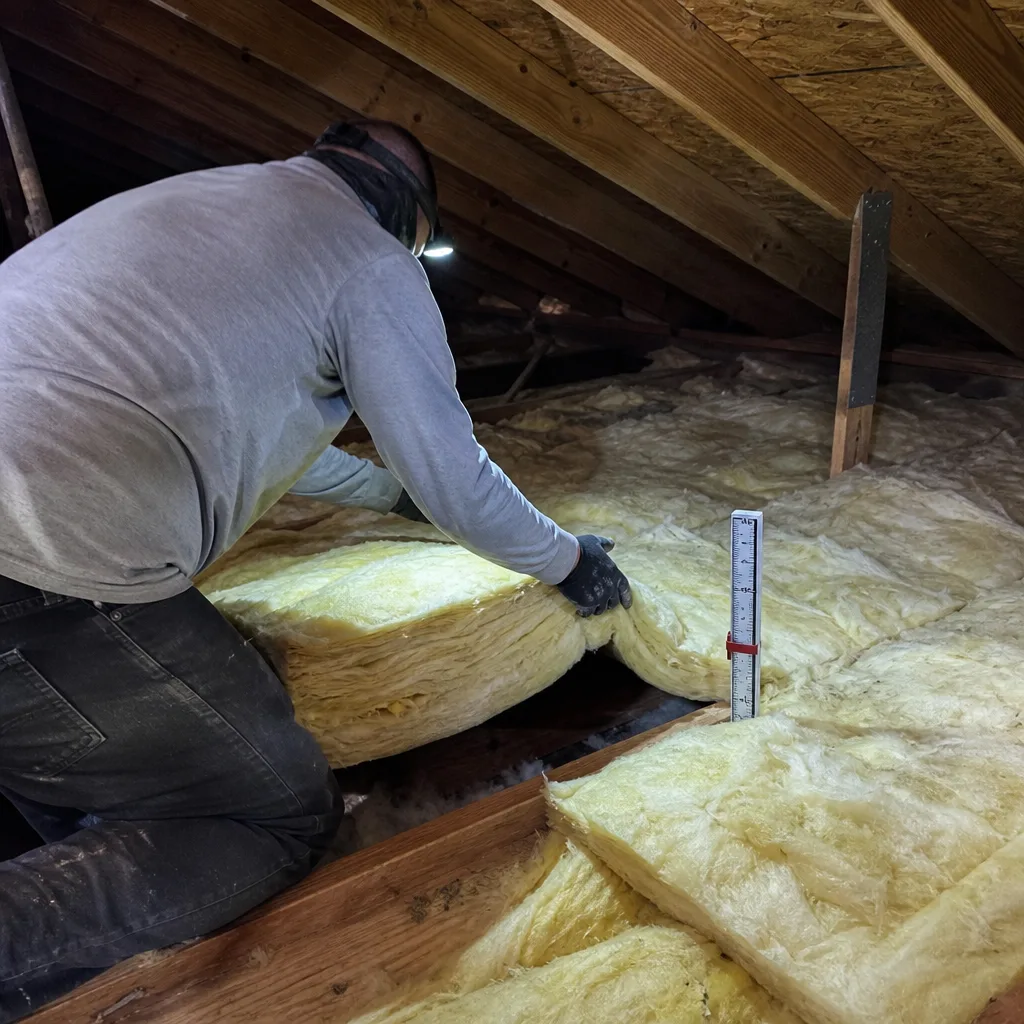
Round Rock’s summer is not just hot, it’s long. From May through October, attic temperatures in unventilated or poorly ventilated spaces regularly reach 140°F and hold there for weeks. This sustained thermal load creates two specific failure modes we see on hundreds of attic insulation in Round Rock jobs every year.
Compressed insulation against soffit baffles. Blown-in cellulose or fiberglass settles over time. When it drifts against the baffles that maintain airflow from soffit vents to ridge vents, it chokes the ventilation path. The attic overheats, which in turn superheats the HVAC ducts running through it. We’ve measured attic air temperatures of 155°F in Round Rock’s Paloma Lake neighborhood where insulation had completely blocked soffit intake. The homeowner’s cooling bill had climbed 34% over three years; they assumed the AC was failing.
Here’s what to check each May:
- From the attic floor, look along the eaves. You should see daylight through every soffit vent, and the baffle vents (the foam or cardboard chutes between rafters) should be visible and unobstructed for their full height.
- Check for insulation drift. Blown material migrates toward the center of the attic over years of thermal cycling and foot traffic from cable technicians. If the eaves are thin and the center is deep, redistribution is needed.
- Inspect HVAC duct connections. Flexible duct, common in Round Rock homes built 2005-2015, uses a metal collar and tape seal at each register boot. Thermal expansion and contraction loosen these. Look for separated collars, tape that has turned to powder, or ducts that have pulled entirely off the boot. A disconnected supply duct in a 140°F attic is dumping conditioned air you paid to cool into a space you never enter.
- Verify ridge vent integrity. The plastic or metal ridge vent cap should sit flat, with no gaps or lifted edges. Round Rock’s spring storm season, March through May, often loosens ridge fasteners before summer heat arrives.
The fix for blocked soffit baffles is not more insulation. It’s air sealing first, then proper ventilation, then insulation at the correct depth. At Envelope Insulation Co., we won’t blow new material over an unsealed attic floor. We seal top plates, can lights, and wire penetrations before any insulation goes in. The homeowner receives a written scope, a written price before any work starts, and on applicable jobs, before-and-after blower-door numbers showing the actual air-leakage reduction. Not sure whether to tackle this yourself? Read our DIY vs Professional Insulation: The Round Rock Homeowner’s Decision Guide.
What thermal cycling does to ducts: Each summer day in Round Rock, flexible duct expands as the attic heats, then contracts overnight when the attic drops to maybe 90°F. After a decade, the inner liner cracks, the insulation jacket compresses, and the R-value, already modest at R-6 or R-8, effectively halves. If your ducts are 15 years old and your summer cooling bills are climbing despite a recently serviced condenser, duct degradation in the attic is the likely cause.
Pre-Winter Inspection Focus: Post-2021 Freeze Awareness
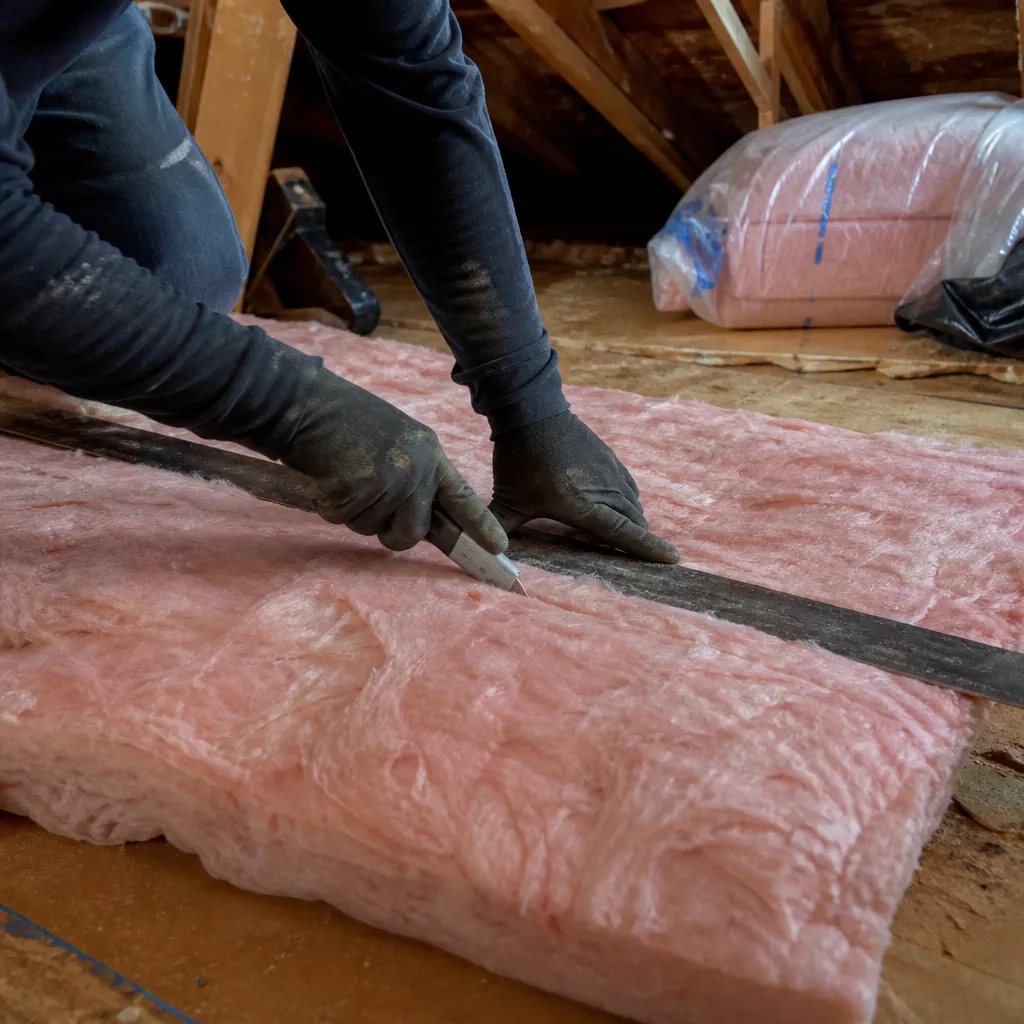
The February 2021 freeze rewrote what Round Rock homeowners need to know about winter insulation risk. Temperatures hit -2°F in Williamson County. Pipes froze in attics that had never frozen before. And the damage pattern was specific: not gradual cold infiltration, but sudden, catastrophic failure when attic temperatures dropped below the pipe’s exposure threshold.
Since 2021, our pre-winter inspections focus on three elements most guides ignore.
Pipe exposure in unconditioned attic space. Any water line running through an unconditioned attic is at risk when temperatures drop into the teens. The 2021 freeze showed that even pipes with modest insulation wrap failed when wind drove cold air through bypasses at light fixtures, chases, and top plates. We now look for:
- Insulation displacement around water lines, especially near the attic hatch where work over the years has pushed material aside
- Spray foam or fiberglass wrap that has degraded, compressed, or pulled away from the pipe
- Pipe runs near gable-end vents or other openings where wind infiltration is highest
- Evidence of prior freeze damage: spray pattern staining on the underside of the roof deck, indicating a past burst that was repaired but not fully remediated
Spray pattern staining. This is the tell we teach homeowners to spot. When a pipe bursts in an attic, the pressurized spray fans out in a characteristic pattern against the nearest surface, usually the roof deck or a rafter. The water dries, but the staining remains: a faint, radial discoloration in the wood. In Round Rock’s Forest Creek and Behrens Ranch neighborhoods, we’ve found this evidence in attics where the homeowner had no idea a freeze event had ever occurred. The prior owner repaired the pipe, never mentioned the incident, and the compromised insulation was never replaced.
Insulation saturation from prior events. Wet insulation, even if dried, loses R-value permanently. Cellulose mats. Fiberglass clumps. Spray foam can delaminate from the substrate. If you find staining, the insulation in that zone needs assessment, not just a glance.
Under Haven Standard Clause 1, every job we perform begins with a written price before any work starts. If we find freeze damage during a pre-winter inspection, the homeowner receives a documented photo record of the affected area, a written scope of remediation, and a flat price. No work proceeds without explicit written authorization.
Stack Effect Reversal: What Hard Freezes Do to Your Envelope
Most Round Rock homeowners understand stack effect in summer: hot air rises, escapes through attic bypasses, and pulls replacement air in through lower leaks. Winter reverses this. During a hard freeze, the house becomes the warm tower. Cold air is denser, so it pushes in through upper bypasses, driving warm, moist interior air outward through lower leaks. The pressure dynamics invert, and the locations where air moves change.
This matters because air sealing without insulation, or insulation without air sealing, fails differently in each season.
Here’s what happens during a Round Rock hard freeze, the kind that drops to 15°F or below for 48 hours:
- The attic temperature plummets, often matching outdoor conditions within hours if insulation is thin or ventilation is excessive.
- The warm interior air, now under positive pressure relative to the cold attic, seeks escape paths through interior wall top plates, electrical chases, and plumbing stacks.
- At these bypasses, the air passes through insulation that was never designed to stop airflow, only slow conductive heat loss. The air cools rapidly.
- When this cooled, still-moist air hits the interior surface of an exterior wall, it can drop below dew point. Condensation forms on interior wall surfaces, not exterior. Homeowners see moisture at baseboards, outlet covers, and window stools and assume a window leak or foundation issue.
We’ve inspected homes in Round Rock’s Teravista neighborhood where interior wall condensation during the December 2022 freeze was misdiagnosed as a slab leak. The actual cause: a top plate bypass above a hallway that had been air-sealed with caulk but never insulated with packed fiberglass or spray foam. The caulk stopped summer exfiltration but did nothing to prevent winter infiltration at that same location.
The correct detail, and the one we specify under The Haven Standard, is seal-then-insulate at every bypass. Air sealing addresses pressure-driven flow. Insulation addresses conductive and convective loss. One without the other leaves a seasonal vulnerability.
Our blower-door test, a pressurization reading that shows in one number how much air your building envelope is losing, quantifies this. A typical Round Rock home of 2,200 square feet built 2005-2015 tests at 3,500-5,000 CFM50 before work. After comprehensive air sealing and insulation, we target 2,000-2,500 CFM50. The homeowner receives the before-and-after numbers in writing, with the documented photo record, so the performance change is verifiable, not promised.
Two Metrics Homeowners Can Track Themselves
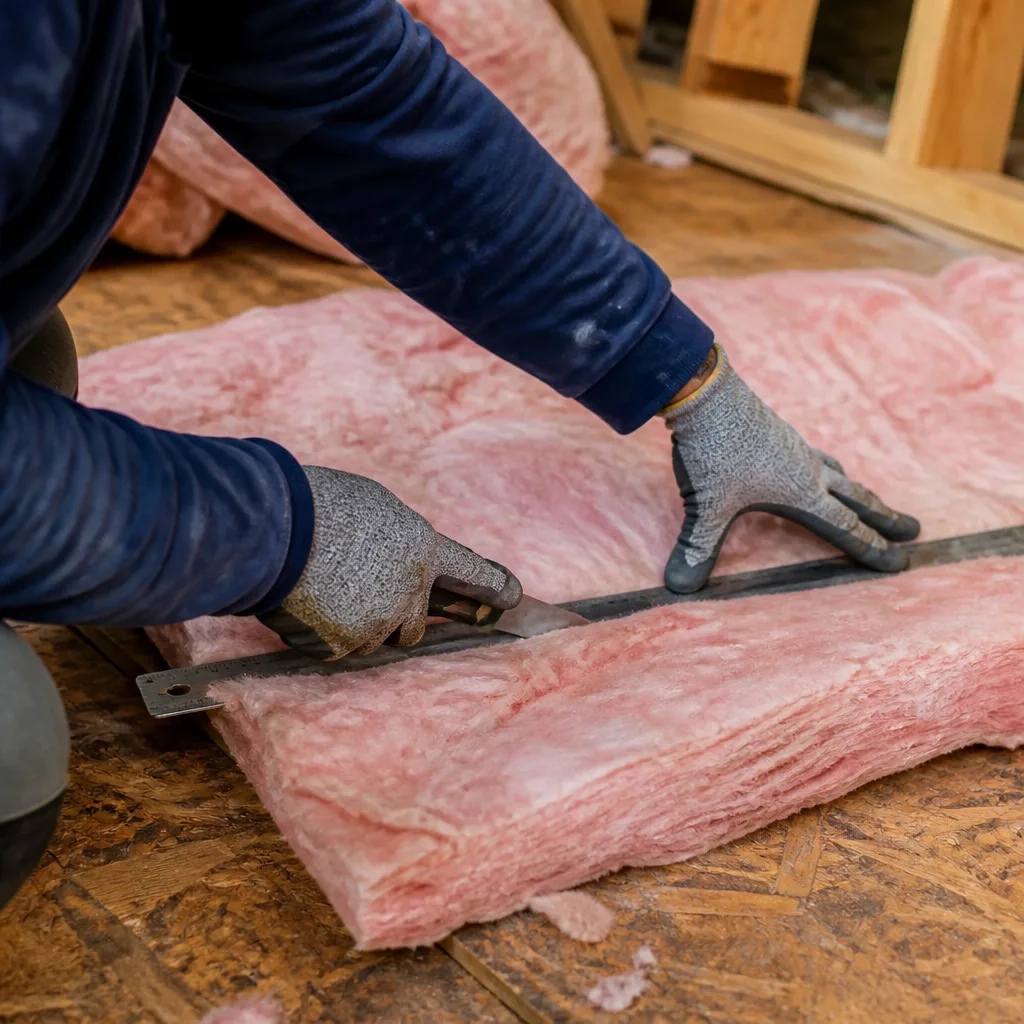
You don’t need our equipment to monitor your insulation performance year to year. Two simple metrics, tracked seasonally, will tell you when something has degraded before your utility bill screams it.
Metric 1: Attic peak temperature.
Buy a $15 min-max thermometer, the kind with a remote sensor on a wire. Place the sensor at attic midspan, roughly halfway between the ridge and the eaves, suspended from a rafter so it’s not touching insulation or ductwork. Record the maximum temperature weekly through summer.
In Round Rock, a well-ventilated, properly insulated attic should peak at roughly 20-35°F above outdoor ambient. On a 100°F day, expect 120-135°F. If you’re seeing 150°F or higher consistently, you have a ventilation blockage, insufficient insulation depth, or both.
Track this number year over year. A sudden jump of 15°F or more indicates a change: a failed ridge vent, blocked soffits, or displaced insulation from a cable install or rodent disturbance. The sensor costs less than a month of excess cooling.
Metric 2: Utility cost per degree-day.
Degree-days normalize for weather variation. Cooling degree-days (CDD) and heating degree-days (HDD) are published daily for Austin-Bergstrom; Round Rock tracks within 5% of that station.
To calculate:
- Take your monthly electric and gas bills. Separate heating and cooling if you can; in Round Rock, summer bills are almost entirely cooling, winter bills mix heating with baseload.
- Find the total CDD or HDD for that billing period from NOAA or your utility’s online tool.
- Divide your cooling-season bill by CDD, or your heating-season gas portion by HDD.
Example: July bill of $340, 620 CDD. Cost per CDD = $0.55. Next July: $410, 600 CDD. Cost per CDD = $0.68. That’s a 24% increase in normalized consumption. The weather was similar; your envelope performance degraded.
Common causes we find in Round Rock when this number climbs: duct separation in the attic, insulation compression from storage or foot traffic, or air-seal failure at a previously sealed bypass. The metric catches these before they’re visible.
We provide a free second opinion on any written estimate, including your own assessment of what needs attention. Bring us your degree-day trend and attic temperature log; we’ll read them with you and tell you whether professional testing is warranted.
Post-Storm Protocol for Hail and Wind Events
Round Rock sits on the eastern edge of Texas Hill Country, where spring and fall severe weather trains produce hail up to golf-ball size and straight-line winds that have measured 80+ mph. The insulation damage from these events is rarely direct. Hail doesn’t typically penetrate roof decking to hit insulation. But the envelope breach comes from above, through components that fail and admit rain-driven moisture.
Ridge vent damage. Plastic ridge vents, common on homes built 2000-2015, crack under hail impact. The crack may be hairline and invisible from the ground. Wind then lifts the vent section, creating a gap that admits water directly onto the top layer of blown-in insulation. Cellulose wicks moisture laterally; fiberglass channels it downward. Either way, the top 2-4 inches become saturated.
Displaced soffit covers. Aluminum or vinyl soffit panels blow inward or outward in straight-line wind events. The resulting gap admits rain at an angle, wetting insulation at the eaves. This is harder to spot from inside because the wetting is at the perimeter, and homeowners rarely inspect eave insulation closely.
Gable vent louvers. These often lose fasteners or bend inward, creating a direct rain path to attic insulation near the gable end.
Post-storm inspection protocol:
- Wait for the storm to pass and the roof to dry, typically 24-48 hours. Wet roofs are dangerous; never inspect during or immediately after severe weather.
- From the ground, binocular-scan the ridge line for lifted, cracked, or missing vent sections. Check gable vents for bent or missing louvers. Walk the perimeter looking for soffit panels that are sagging, missing, or wind-flapped.
- If any of these are compromised, enter the attic with a bright flashlight. Inspect the top layer of insulation directly below each breach. Wet cellulose darkens and mats. Wet fiberglass clumps and loses loft. Either condition requires removal of the affected material and repair of the breach before replacement.
- Check for staining on the roof deck beneath each breach. Fresh water stains are yellowish; older stains are brown or black. Multiple stain colors suggest recurring, unaddressed leaks.
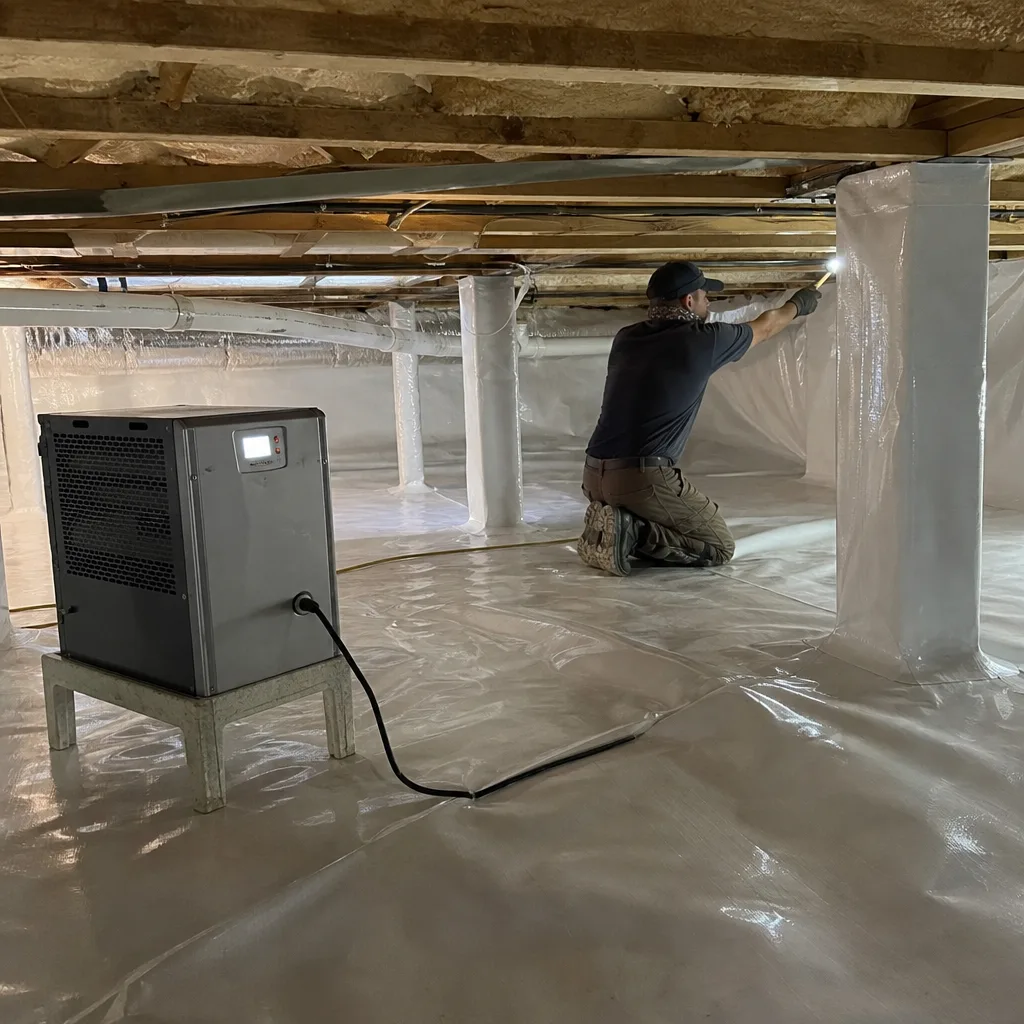
We include crawl space encapsulation and vapor barrier in Round Rock as part of our full envelope service line, and the same post-storm logic applies: inspect the vapor barrier for punctures, check sump operation if present, and verify that foundation vents haven’t been blocked by debris that would trap moisture.
Our 365-Day Done Right Promise applies to all completed work. If a storm breaches an area we sealed and insulated, we make it right. The promise is backed by a written warranty delivered before anyone starts, per Haven Standard Clause 1.
Insulation Materials That Hold Up in Round Rock’s Climate
Not every insulation product performs equally across our two stress seasons. The summer-winter swing in Round Rock, from sustained 140°F attic temperatures to occasional teens, tests material stability more than climates with milder extremes.
Blown-in fiberglass (Knauf Jet Stream, Owens Corning AttiCat). Excellent for attic floor applications where ventilation is good. Doesn’t absorb moisture, so post-storm wetting is less damaging than cellulose if dried promptly. Settles less than cellulose over time. We specify Knauf’s stabilized product for Round Rock attics where homeowners use the space for storage and foot traffic is likely.
Blown-in cellulose (GreenFiber, certain Johns Manville products). Higher R-value per inch, better at blocking air movement in settled form. The tradeoff is moisture sensitivity. Wet cellulose must be removed; it cannot be dried in place. We use cellulose primarily in enclosed wall cavities and for homeowners who commit to maintaining ventilation integrity.
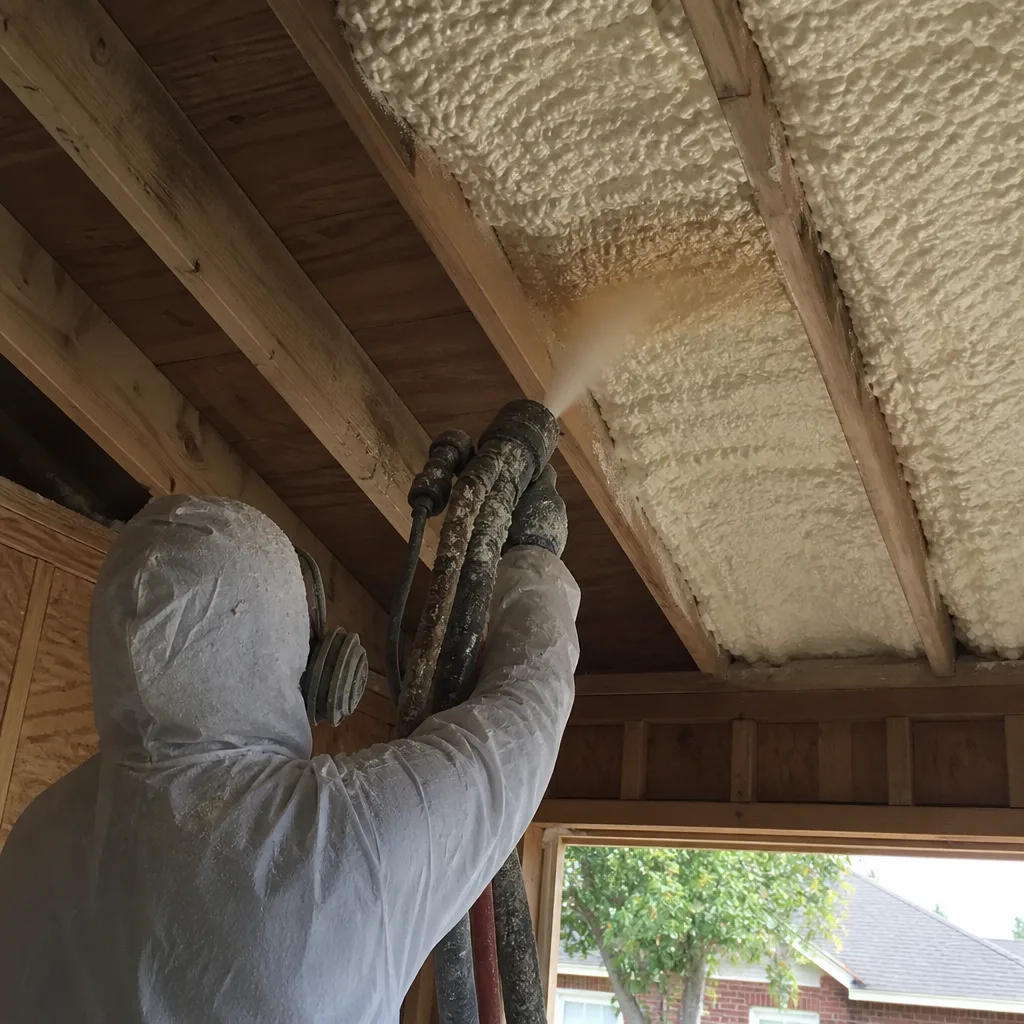
Spray foam (Icynene, Demilec, certain closed-cell products). The only material that simultaneously air-seals and insulates. Spray foam insulation in Round Rock is our specification for rim joists, kneewalls, and any area where blower-door testing shows persistent leakage that fibrous insulation cannot address. Open-cell foam is vapor-permeable; closed-cell is vapor-impermeable. The choice depends on the assembly and whether we need to manage moisture diffusion, not just air leakage.
Mineral wool (Rockwool Comfortbatt). Fire-resistant, water-repellent, and dimensionally stable across temperature swings. We use Rockwool in specific applications: around masonry chimneys where clearance to combustibles is required, and in interior partition walls where acoustic performance matters. It’s not typically cost-effective for full attic coverage but excels where its properties are needed.
Radiant barrier. Not insulation in the conductive sense, but a critical component in Round Rock’s latent-heat summer. A properly installed radiant barrier, stapled to rafters with proper air gap, can reduce attic peak temperatures by 20-30°F. We install radiant barrier as part of comprehensive attic systems, never as a standalone fix for inadequate insulation depth.
Materials are sourced from Owens Corning, Johns Manville, Knauf, Rockwool, CertainTeed, Icynene, Demilec, and GreenFiber. We specify by application, not by brand exclusivity. No proprietary product lock-in means the recommendation is based on your home’s condition, not a distributor incentive.
Every job closes with a Documented Photo Record, included on every visit, not available on request. The photos show material depth, coverage uniformity, sealed bypasses, and any conditions encountered. The homeowner keeps this record for warranty, resale disclosure, or future comparison.
Common Mistakes to Avoid
- Adding insulation without checking ventilation first. In Round Rock, this is the most common error we correct. New blown-in material compressed against soffit baffles turns an overheated attic into a superheated one. Ventilation paths must be verified and cleared before any insulation is added.
- Assuming winter is the low-stress season. The 2021 freeze proved otherwise. Pre-winter inspections should focus on pipe exposure and prior freeze damage, not just a glance at insulation depth.
- Ignoring post-storm attic entry. Hail damage to ridge vents and soffits is invisible from the ground until insulation is already wet. A 15-minute attic check after severe weather prevents mold and R-value loss.
- Tracking raw utility bills instead of cost per degree-day. A $400 July bill after a mild summer looks better than a $380 bill after a scorching one. Normalized metrics reveal actual envelope performance.
- Air sealing without insulating bypasses, or insulating without air sealing. Either half-measure fails seasonally. The stack effect reversal during hard freezes will find every bypass that was sealed but not insulated, producing interior condensation that mimics a leak.
- Storing items on blown-in insulation. Every storage board compresses material beneath it, creating a thermal short. In Round Rock’s summer, these shorts become radiant heat sinks that increase cooling load locally. Use raised storage platforms that span joists, or better, store elsewhere.
- Waiting for a problem to call. By the time utility bills spike or interior moisture appears, insulation damage is often extensive. Seasonal inspection, even brief, catches degradation early.
When to Call a Professional
Call for a professional assessment when your attic peak temperature exceeds 150°F consistently, when you find spray-pattern staining or wet insulation, when your cost per degree-day climbs 15% year over year, or when post-storm inspection reveals damaged vents or moisture. Also call if your home was built 2005-2015 and has never had a blower-door test; this era in Round Rock construction often has specific air-sealing gaps at tub and shower surrounds, fireplace chases, and dropped soffits that are invisible without pressurization testing.
Topside Attic Insulation Round Rock home offers free estimates in Round Rock. A trained technician will inspect your attic, document conditions with photos, and provide a written price before any work is discussed. Call (737) 259-7528 to schedule. Calls are answered by a live person, 24/7.
Frequently Asked Questions
Most attic insulation jobs in a 2,000-square-foot Round Rock home run between $2,800 and $5,400 for blown-in fiberglass to current code depth, including air sealing of top plates, can lights, and penetrations. Spray foam applications for rim joists or kneewalls typically range from $1,800 to $3,200 per treated area. Every job receives a written price before any work starts, per Haven Standard Clause 1. Call (737) 259-7528 for an exact quote on your home; estimates are free.
Insulation can be installed year-round in Round Rock, and summer is actually preferable for identifying ventilation problems that winter hides. A crew working in a 140°F attic is uncomfortable, which is why we schedule attic work for morning hours and verify ventilation is functional before adding material. The key is never adding insulation over an unsealed attic floor; the season matters less than the sequence. Explore more guides & resources on attic performance and home efficiency.
Inspect the underside of your roof deck and rafters for spray-pattern staining, radial discoloration that indicates a past pipe burst. Check whether wet insulation was removed or merely dried in place; compressed, matted, or clumped material was likely wet and is now compromised. If you find staining or suspect incomplete remediation, a professional assessment with documented photos will clarify what remains to be addressed.
Localized wetting from a single storm breach can sometimes be remediated by removing 2-4 inches around the affected area, drying the deck, and replacing with matching material. Widespread moisture, settled cellulose, or fiberglass that has lost loft requires full replacement. Repair is cheaper only when the damage is caught early and the source is definitively fixed; delayed action usually forces replacement. We provide a free second opinion on any written estimate to help you compare options.
Perform a brief visual inspection each May before summer stress and each November before winter risk. After every severe hail or wind event, check ridge vents, soffits, and gable vents from the ground, then enter the attic if any breach is suspected. Track attic peak temperature and utility cost per degree-day continuously; these metrics flag problems between inspections.
A blower-door test is a pressurization reading that shows, in one number, how much air your building envelope is losing. The equipment mounts in an exterior door and depressurizes the house to a standard 50 Pascals; the resulting CFM50 figure quantifies total leakage. We recommend one for any Round Rock home built before 2015 that has never been tested, or whenever utility costs per degree-day climb unexpectedly. On applicable jobs, we provide before-and-after blower-door numbers so the homeowner can verify the air-sealing result in writing.
The Bottom Line
Round Rock’s insulation calendar has two stress seasons, not one. Summer demands ventilation and duct integrity checks. Winter, especially post-2021, requires pipe exposure inspection and awareness of stack-effect reversal at bypasses. Track attic peak temperature and cost per degree-day yourself. Inspect after every severe storm. And remember that insulation without air sealing, or air sealing without insulation, fails when the season turns. The homes that perform best across both extremes are the ones where the envelope was treated as a system: sealed first, insulated second, documented always.
Written by Wes Okafor, Owner at Topside Attic Insulation Round Rock, serving Round Rock since 2016.